
Two very different climate responses are moving from theory to practice in 2026: one involves red worms and wood chips on a California dairy farm; the other involves aircraft, materials, and the industrial reality of solar geoengineering.
In its July 9, 2026 edition of The Download, the daily newsletter from MIT Technology Review, the outlet put those worlds side by side—one rooted in living organisms that can be seen and measured on a farm, the other in heavy infrastructure that would attempt to alter Earth’s incoming sunlight. The common thread: rising pressure to deliver measurable environmental results.
A third-generation California dairyman tries “vermifiltration” to clean manure wastewater
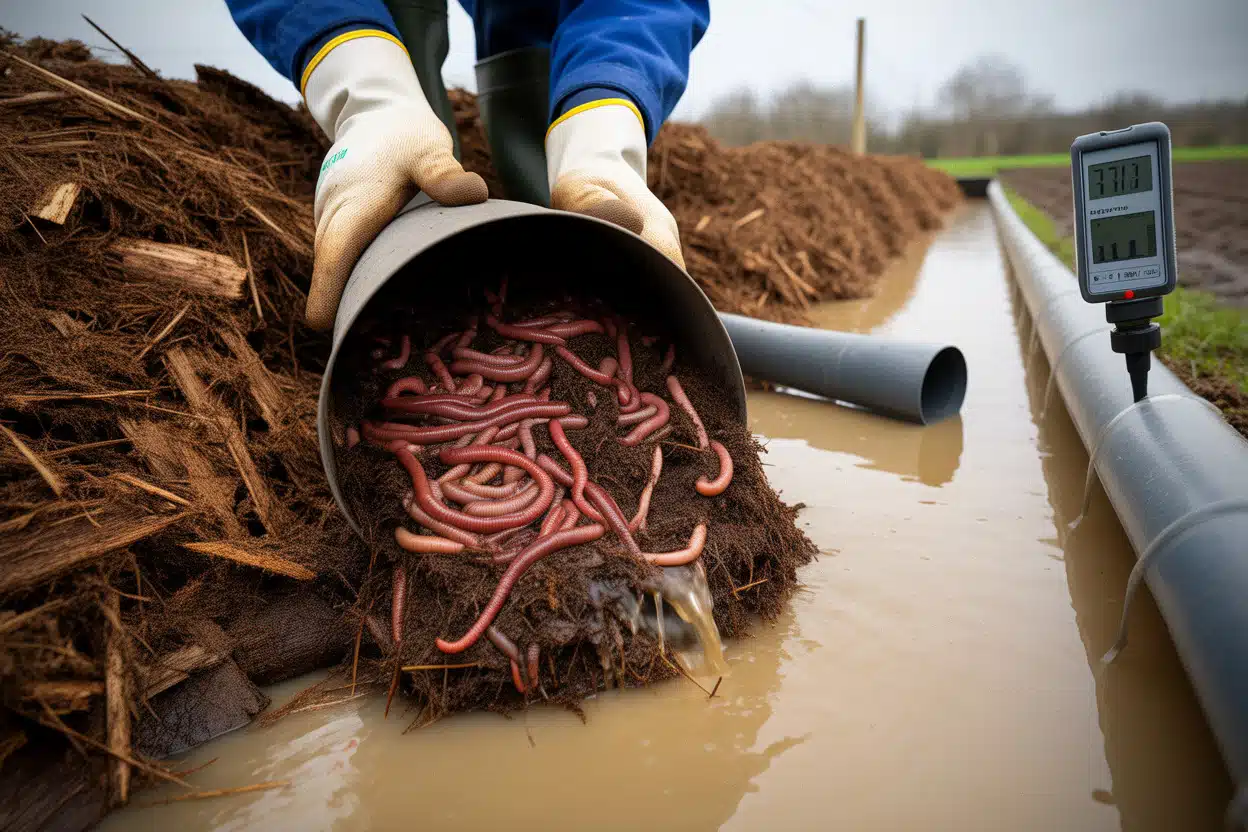
On a California dairy, farmer Anthony Agueda—described as a third-generation producer—stirs a dark, damp bed of wood chips. Red earthworms surface briefly, while most of the biomass—potentially hundreds of thousands of worms—remains buried below.
The setup is an example of vermifiltration, a treatment approach that relies on worms and microbes rather than conventional mechanical systems to help clean wastewater from manure. The idea is to let water loaded with organic matter percolate through a filter medium where biological activity transforms compounds, reduces odors, and lowers the pollution load.
As framed in The Download, the climate angle is central. Vermifiltration is presented as a way to cut emissions of methane and nitrous oxide—two potent heat-trapping gases—while also limiting water pollution. Because emissions from manure vary widely depending on how it’s stored and treated, manure management is one of the levers farms can directly pull.
The newsletter also treats vermifiltration as one option among many, alongside phase separation, covering manure pits, anaerobic digestion, biological treatments, and changes in how manure is applied. The appeal of the California example is its tangibility: visible organisms, a substrate, a flow of wastewater—and the possibility of measuring what comes out the other end.
Why manure pollution is pushing farms toward trackable, on-the-ground fixes
Manure concentrates multiple environmental problems at once: high organic loads, excess nutrients, runoff risks, odors, and greenhouse-gas emissions during storage and land application. The Download describes an industry facing growing pressure to document reductions in impacts from an activity already under scrutiny.
That pressure isn’t only about adopting new technology. It’s also about whether results can be tracked, whether performance holds up over time, and whether systems fit the day-to-day constraints of working farms.
Biological approaches can draw interest because they can be deployed at different scales and integrated into existing infrastructure. But the article notes practical hurdles that shape adoption—process stability, sensitivity to temperature swings, manure volumes, maintenance needs, and access to filtering materials.
Systems built around worms and microbes also require managing a living environment—moisture, oxygenation, and periodic replacement of the substrate—meaning farmers may need new expertise or specialized service providers. For public officials, the attraction is the combined water-and-climate benefit; for farms, the tradeoffs include capital costs, operating costs, and the risk of noncompliance.
Solar geoengineering gets a “reality check” as researchers confront industrial constraints
At the other end of the spectrum, The Download highlights what it calls a reality check for solar geoengineering—the controversial idea of deliberately intervening in the climate system to counter some warming. The key shift described is a move away from a debate dominated by computer simulations toward questions shaped by engineering limits.
That doesn’t mean deployment is imminent, the newsletter argues. But it does mean the discussion is increasingly about verifiable requirements: materials, aerial platforms, logistics, and safety.
According to the text, teams are working on aircraft, materials, and other systems that would be needed for any potential implementation. The point is the gap between theoretical physical feasibility and industrialization. Even a limited program would require choices about delivery platforms, maintenance cycles, supply chains, and observation protocols to measure effects.
The newsletter also emphasizes governance: changing Earth’s radiative balance carries risks, and consequences could vary by region. And it argues that even an early deployment would require new infrastructure, significant time, and major investment—challenging the idea that solar geoengineering could be a quick, relatively cheap alternative to cutting emissions.

Placed together, the two stories underline a stark contrast. Vermifiltration targets a defined pollution source—manure—aiming for measurable changes in water quality and emissions of methane and nitrous oxide. It relies on familiar biological mechanisms: digestion of organic matter, microbial transformation, and filtration through a substrate. Its main limitation is scale and variability in operating conditions, which is why it must be weighed against other manure-treatment options.
Solar geoengineering, by contrast, would aim at a global lever—how much sunlight Earth receives—making it potentially powerful but technically and politically risky. As The Download frames it, the move into engineering constraints—planes, materials, infrastructure—makes the concept less speculative and more like a major long-term program with ongoing maintenance, monitoring, and accountability.
Economically, the logic diverges as well. A farm-level system can be justified through compliance gains, reduced nuisance impacts, and potential savings on treatment. A geoengineering effort would require budgets, teams, equipment, and logistics far beyond the local level. In both cases, though, credibility hinges on the same thing: the ability to measure, repeat, and report results under real-world constraints.
Questions frequently asked
What is vermifiltration for manure? Vermifiltration is a treatment process in which earthworms and microbes in a filtering medium help clean wastewater from manure by reducing organic load and certain pollutants.
What environmental benefits are these biological systems aiming for? The system is presented as potentially reducing water pollution from manure effluent and lowering greenhouse-gas emissions—especially methane and nitrous oxide—linked to manure management.
Why is solar geoengineering described as entering a more concrete phase? The topic is moving beyond simulations to engineering constraints: aircraft design, material choices, infrastructure needs, timelines, and the investments required even for limited deployment.
Can solar geoengineering be deployed quickly? The text argues that even early implementation would require new infrastructure, time, and significant investment—making it far more involved than a one-off intervention.
Key takeaways
Vermifiltration pairs worms and microbes to treat manure wastewater, with the stated goal of cutting methane, nitrous oxide, and water pollution. Solar geoengineering, meanwhile, is running into the practical demands of aircraft, materials, and infrastructure—suggesting that even small-scale steps would take time and major investment.
Sources
The Download: worms fight pollution, and geoengineering faces reality | MIT Technology Review
The Download: worms fight pollution, and geoengineering faces …
The Trump administration has lifted restrictions on OpenAI's GPT 5.6.
Worms Fight Pollution; Geoengineering Gets Real — AI Pulse
Key Takeaways
- Vermifiltration combines worms and microbes to treat manure wastewater.
- The stated goal is to reduce methane, nitrous oxide, and water pollution.
- Solar geoengineering faces constraints related to aircraft, materials, and infrastructure.
- The first steps would require time and significant investment, even at a small scale.
- In 2026, two opposing climate approaches coexist: local biological solutions and large-scale atmospheric intervention.
Frequently Asked Questions
What is vermifiltration applied to manure slurry?
Vermifiltration is a treatment process in which earthworms and microbes, housed in a filter medium, help clean wastewater from manure slurry by reducing the organic load and certain pollutants.
What environmental benefits are these biological systems intended to achieve?
The system is presented as potentially reducing water pollution from effluents and lowering greenhouse gas emissions—especially methane and nitrous oxide—associated with manure slurry management.
Why is solar geoengineering described as entering a more concrete phase?
The topic is gradually moving beyond simulations alone to address engineering constraints—aircraft design, material choices, infrastructure needs, timelines, and the investments required even for limited deployment.
Can solar geoengineering be deployed quickly?
The text emphasizes that even an early rollout would require new infrastructure, time, and major investment, making it more involved than a one-off intervention.
Sources
- The Download: worms fight pollution, and geoengineering faces reality | MIT Technology Review
- Home | MIT Sloan Club of NY
- The Download: worms fight pollution, and geoengineering faces …
- The Trump administration has lifted restrictions on OpenAI's GPT 5.6.
- Worms Fight Pollution; Geoengineering Gets Real — AI Pulse