The real question for U.S. businesses isn’t whether solar power makes sense anymore, it’s how to build a system that produces electricity when the company actually needs it, at a cost that pencils out, on land the business can afford to use.
That’s why the choice between traditional fixed solar panels and sun-following “tracker” systems is more than a hardware debate. It can reshape a company’s energy strategy, boost on-site consumption, cut utility purchases at the most expensive hours, and even influence how an industrial, agricultural, or logistics site is laid out and operated.
Why “more kilowatt-hours” doesn’t automatically mean “more value”
On paper, the comparison looks straightforward. Fixed panels sit at a set tilt and direction, often optimized to capture the most sunlight over the year. Trackers move with the sun, stretching production into the morning and late afternoon.
But businesses don’t pay their electric bills in annual totals, they pay based on when they pull power from the grid. A kilowatt-hour produced at noon, when solar output is already flooding the system, may be less useful than a kilowatt-hour produced at 8 a.m. or 5 p.m., when equipment ramps up, refrigeration runs hard, or shifts change.
That’s where trackers can change the economics. By spreading production more evenly across the day, they can better match a facility’s load profile, often improving “self-consumption,” or the share of solar power used on-site instead of exported back to the grid.
Fixed panels: dependable, simpler, and often the easiest win
Fixed systems have a big advantage: simplicity. Fewer moving parts. Standardized engineering. More predictable installation costs. For many commercial projects, that reliability and clarity still make fixed panels the default choice.
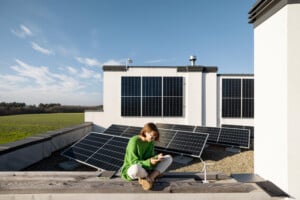
They’re especially strong on warehouse and factory rooftops, carport canopies over parking lots, and other space-constrained sites. Businesses can cover large areas quickly, keep maintenance relatively low, and get performance that’s easy to forecast.
The tradeoff is structural: fixed arrays tend to peak when the sun is highest. For operations whose demand also peaks midday, that’s perfect. For others, farms that start early, cold-storage facilities, food processing, or companies running long hours, the production curve may not line up with when power is most valuable.
Solar trackers: not just more power, different power
A tracker system does one basic thing: it points panels toward the sun instead of waiting for the sun to hit the panels at the right angle. That can lift annual output versus a fixed array, with gains depending on local sunlight, site layout, equipment, and controls.
But for many businesses, the bigger advantage isn’t the extra production, it’s the shape of that production. Trackers can deliver more electricity earlier and later in the day, which can be a better fit for real-world operations.
Think of an agricultural operation that draws power in the morning for milking, irrigation pumps, ventilation, or cooling. Or an industrial shop that starts early. Or a logistics hub with energy use spread across a long operating window. In those cases, trackers can reduce grid purchases across more hours, not just during the solar “noon spike.”
Land can make the decision for you
Solar projects don’t happen in a vacuum. Available space, zoning and permitting constraints, access roads, shading, and existing site uses all shape what’s feasible.
Fixed panels are typically more space-efficient. They can pack more capacity into a given footprint, which is why they’re a natural fit for rooftops. On parking lots, fixed solar canopies can also pull double duty, generating power while shading vehicles.
Trackers usually need more spacing to avoid panels shading each other and to allow movement. That can sound like a drawback, until you’re looking at a business with plenty of open ground: farmland, underused industrial parcels, buffer land around buildings, or other low-value acreage.
In those situations, the question shifts from “How many panels can we cram in?” to “How much useful electricity can we produce without disrupting operations?” That’s often the more important business metric.
Maintenance and reliability: should businesses worry about moving parts?
The common knock on trackers is obvious: moving systems break more than stationary ones. It’s a fair concern, but it’s not the whole story.
Yes, trackers add mechanical components and control systems that fixed arrays don’t have. That means design quality, monitoring, and preventive maintenance matter. But commercial buyers already evaluate critical equipment this way: uptime, service access, parts availability, warranties, and operating history.
And fixed systems aren’t immune to problems. Poor design, sloppy installation, or weak monitoring can drag down performance just as easily. In practice, reliability often comes down less to “tracker vs. fixed” and more to engineering, vendor quality, and how the system is operated.
Cost and payback: don’t stop at the upfront price tag
At similar project sizes, fixed panels often look cheaper upfront. The cost per installed watt is typically lower, and the financial model is easier to explain to decision-makers.
But upfront capital cost isn’t the whole equation. Trackers can cost more to install, yet generate more electricity, and, crucially, generate it at times when it can replace higher-value grid purchases. If that extra morning-and-evening production is consumed on-site, the economics can swing.
To compare options realistically, businesses need to weigh at least four factors:
- the site’s hourly electricity demand profile;
- expected self-consumption (how much solar will be used on-site);
- the amount of truly usable space (roof or ground);
- whether the company can shift or control loads (equipment schedules, storage, EV charging, etc.).
A facility that runs steady daytime operations will make different choices than a farm with heavy early-morning loads or an office site that’s quiet on weekends. Commercial solar performs best when it’s designed around how energy is used, not just how much space is available.
Which option fits which kind of business?
For a small or mid-size manufacturer with a large, unshaded roof, fixed panels can be the cleanest deal: straightforward installation, limited maintenance, and a natural building integration.
For agriculture and food-related operations with demand spread across the day, trackers deserve a serious look, especially when the business needs power outside the midday peak.
For companies with open land, the decision often comes down to a tradeoff between packing in maximum capacity (often favoring fixed) versus producing electricity that better matches operations (often favoring trackers). The “best” answer depends on how the site runs and how long the company plans to hold the asset.
And for businesses pursuing a broader energy strategy, on-site consumption, batteries, load management, fleet electrification, or electrifying heat, no single technology wins by default. The best system is the one that fits into a larger plan to treat energy as a controllable asset, not just an overhead cost.
Bottom line
The smartest solar choice isn’t the one that looks best on a spec sheet. It’s the one that produces the most useful electricity for the business, at the right hours, on the right footprint, with a payback that holds up under real operating conditions.
As electricity pricing becomes more time-sensitive and companies get more serious about managing energy, the tracker-versus-fixed debate will increasingly hinge on hourly value, land efficiency, and how well a business can actively run its power system, not just install it.