
Pope Leo XIV has put artificial intelligence at the center of his first encyclical, Magnifica Humanitas, published in late May 2026—framing AI not as a niche tech policy issue but as a global moral test.
Across the text and in remarks carried by Vatican News and mainstream outlets, Leo XIV warns that AI systems—especially generative tools, automated decision-making, and the concentration of digital infrastructure—are already reshaping access to jobs, public services, and information. His core concern: technology that starts serving power more than people.
The pope’s signature phrase, a call to “disarm” AI, is meant to shift the debate away from raw performance and toward ends and power—who controls these systems, who benefits, and what happens when humans are nudged, scored, or ruled by machines.
“Magnifica Humanitas” treats AI as a defining challenge to what it means to be human
In Magnifica Humanitas, Leo XIV describes AI as an issue that reaches beyond familiar arguments about productivity or innovation. He focuses instead on what he calls a transformation of power—“technological power” taking on an unprecedented face—linking algorithms to concrete realities: how work is organized, how information is accessed, how content is selected, and how people are evaluated, sometimes without a clear way to challenge decisions.
The encyclical repeatedly returns to the risk of a humanity reduced to what can be computed. Vatican News highlighted the pope’s warning about a human being reduced to “a set of data”—a critique that points to already common practices such as automated ratings, scoring systems, ad targeting, and resume filtering. In that environment, the text argues, dignity can be weakened when the complexity of a life is translated into indicators—and when mistakes become hard to correct because decisions are made at scale.
Leo XIV’s argument is also about governance: who owns the models, who controls the infrastructure, and who sets the goals. Coverage of the encyclical emphasizes his warning about benefits concentrating in too few hands. When technological goods remain controlled by a small number of actors—without sharing or access—an imbalance grows, widening the divide between those included and those left out, echoing tensions already visible in access to tools, skills, and computing resources.
By placing AI in an encyclical—a major teaching document in the Catholic Church—the Vatican is asserting a specific role: to bring a moral framework to a debate often driven by deployment speed and industrial competition. The message is global but straightforward: tools should serve people, not the other way around. The novelty, the text suggests, is AI’s scale and reach—its ability to create, influence, and decide, shaping how consciences are formed.
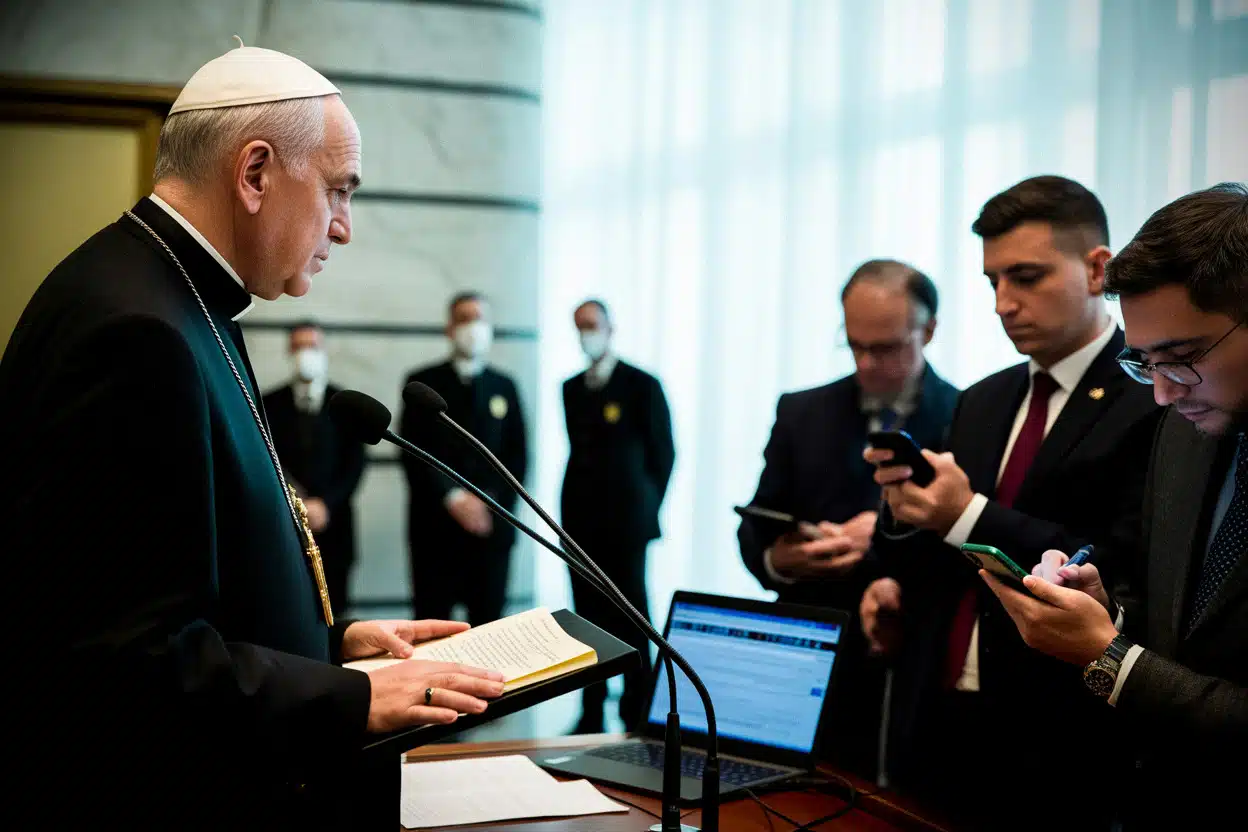
Leo XIV’s call to “disarm” AI targets domination, exclusion, and deadly uses
The phrase “disarm AI” has become the central marker of Leo XIV’s intervention. It does not mean abandoning research, but stripping technology of its ability to dominate human beings. Texts relayed in May and June 2026 describe what the pontiff is aiming at: an AI freed from the logics that turn it into an instrument of domination, exclusion, or death.
The language points directly to coercive uses—mass surveillance, information manipulation, and the automation of violence—as well as the broader spread of systems that steer sensitive decisions. In this view, “disarming” means setting limits on purposes and on the conditions for deployment, not merely reducing a model’s error rate.
A quote reported by RTL Info captures the political edge of the argument: “We must break this equivalence between technical power and the right to govern.” In other words, the ability to produce an automated solution should not, by itself, justify adopting it in areas such as justice, security, health care, or schools.
Leo XIV also stresses the formation of conscience. One presentation of the text emphasizes the need to form consciences capable of living in the age of artificial intelligence without losing freedom—using powerful tools without being dominated by them, and remaining human. Behind that line is a more everyday worry: constant assistance—recommendations, summaries, instant answers—can gradually reduce the effort of thinking and the sense of personal responsibility.
While the encyclical does not lay out a detailed legal blueprint, it points to practical levers: system transparency, democratic oversight, independent audits, traceability of decisions, rights of appeal, and bans on certain uses. As a moral intervention, it may strengthen actors already pushing for guardrails—civil liberties groups, ethics researchers, religious leaders from other faiths, and even companies seeking credibility for compliance efforts.

The warning that drew attention: humans “losing the ability to act”
One of the most discussed passages focuses on what the pope calls the loss of the ability to act. He describes a gradual shift as intellectual and social tasks are delegated—route choices, content selection, sorting relationships, writing, decision-making. Dependence can feel convenient, the text argues, but it carries a cost: weakened judgment, attention, and responsibility, especially when users no longer perceive the constraints imposed by the tool.
At work, the argument becomes concrete. Generative assistants can speed up the production of text, code, or visuals, but they can also standardize methods and reduce autonomy by imposing formats, metrics, and procedures. In sectors where evaluation is automated—call centers, logistics, platform-based work—employees can face opaque decisions about daily targets, penalties, and priorities, without a human interlocutor able to explain. The pope’s emphasis on freedom is aimed at situations where people end up executing what a system calculates.
Culturally, the encyclical also raises concerns about how opinion is shaped. Recommendation systems and synthetic content can change access to information, amplify certain narratives, and make it harder to identify sources. The ability to act, in this framing, is not only physical—it depends on understanding, verifying, and deciding. When AI delivers ready-made answers, it can erode critical thinking, especially if users do not know how results were produced.
Leo XIV grounds the warning in a Christian anthropology that treats each person as having intrinsic value—irreducible to performance or a digital trace. That leads to calls for limits on data processing, but also for a rehabilitation of long time horizons: learning, deliberation, and even acknowledged error. The message is aimed at decision-makers and the public alike, because the weakening of autonomy can be diffuse—built from the accumulation of small daily delegations.
Concentrated AI power, unequal access, and the political debate in 2026
The encyclical highlights the risk of concentration in AI resources and benefits. The required infrastructure—data, chips, computing centers, energy—is expensive, favoring already dominant players. Leo XIV argues that the result can be a widening gap between those included and those excluded: countries able to invest heavily versus dependent countries, large corporations versus small and mid-sized businesses, and workers trained on new tools versus those exposed to automation.
The divide is also territorial. As public services digitize and rely more on automation, unequal access to digital tools can turn promised efficiency into the opposite: more complexity for those less comfortable online, more steps, and greater difficulty reaching a human being. The pope’s warnings resonate with that reality—technology can exclude when it becomes the only doorway. His call for sharing and access is meant to prevent AI from becoming a privileged resource, while its constraints fall on everyone.
In 2026, political responses are increasingly organized around regulation, transparency, and accountability. Public debate focuses on content traceability, limiting certain uses, risk assessment, and protecting fundamental rights. Leo XIV’s intervention adds an ethical frame that can reinforce demands for external oversight—audits, documentation requirements, and mechanisms to contest decisions. The vocabulary of “disarmament” suggests a hierarchy of uses: some should be tightly controlled, or even prohibited, when they threaten life, dignity, or social peace.
The encyclical also lands at a moment when companies promote responsibility charters while continuing a race for performance and adoption. The balance remains fragile, as competitiveness and security are often invoked to justify rapid deployment. In that context, Magnifica Humanitas adds moral pressure—especially on access to benefits, training, redistribution of value, and preventing exclusion.
The text’s immediate impact may be less about a single policy decision than about shaping the terms of the debate. An encyclical carries global reach through educational, civic, and religious networks. For readers—Catholic or not—Magnifica Humanitas argues that AI is not only a technology story, but a story about power, freedom, and human dignity.
Key Takeaways
- Leo XIV makes AI a central topic of his 2026 encyclical, Magnifica Humanitas
- The pope calls to "disarm AI" to prevent domination, exclusion, and deadly uses
- He warns against reducing the human person to "a set of data"
- "Loss of agency" refers to dependence and the opacity of automated decisions
- The text highlights the concentration of technological benefits and the risk of widening inequalities
Frequently Asked Questions
What is Magnifica Humanitas, Leo XIV’s first encyclical?
Magnifica Humanitas is the first encyclical issued by Pope Leo XIV in late May 2026. The text addresses the impacts of artificial intelligence on human dignity, freedom, and power relations, calling for rules to govern uses that could lead to domination or exclusion.
What does Leo XIV mean by calling to “disarm artificial intelligence”?
The phrase refers to the idea of stripping AI of its ability to become a tool of domination. It implies limits on purposes, safeguards, transparency, independent oversight, and—for certain high-risk uses—bans or strict restrictions.
Why does the pope talk about reducing humans to “a set of data”?
Leo XIV criticizes practices that translate a person into profiles and metrics used to sort, score, or make decisions at scale. This kind of approach can undermine dignity, make decisions harder to challenge, and increase discrimination when data or models are biased.
What does the “loss of the ability to act” mentioned by Leo XIV refer to?
It refers to the risk of excessive delegation to automated systems, which can reduce autonomy, judgment, and responsibility. In everyday life as well as at work, algorithmic assistance can trap people in opaque procedures and decisions, leaving them with less control over their choices.
Sources
- Léon XIV : « Il faut désarmer l’IA pour l’empêcher de dominer l’humain »
- Léon XIV met en garde contre la réduction de l’être humain à «un ensemble de données» – Vatican News
- Le pape Léon XIV appelle à « désarmer l’intelligence artificielle », alors que « le pouvoir technologique prend un visage inédit »
- « L’intelligence artificielle doit être désarmée », le Pape Léon XIV présente Magnifica Humanitas
- Le pape craint que l’intelligence artificielle ne « domine l’humain » et appelle à la « désarmer » – RTL Info