
The EV conversation is shifting fast. It’s no longer just “how far can you go on a full charge?” but “how far can you get back in a 10-minute stop?”
In 2026, the spread of high-power charging (HPC) stations and more capable batteries is pushing shoppers and road-trippers toward a more practical yardstick: real range regained in a very short break. Recent comparisons in the auto press highlight three distinct approaches—Tesla’s consistency through its Supercharger network, BYD’s industrial push as it scales globally, and Hyundai-Kia’s 800-volt tech, often treated as a benchmark for fast charging.
Why “range in 10 minutes” comes down to the charging curve—not the peak kW number
Comparing how much range an EV can recover in 10 minutes means looking beyond the maximum charging power listed on a spec sheet. What matters most is the vehicle’s charging curve—how long it can hold high power before it tapers off. A big “peak” number can drop quickly if the battery heats up, if the state of charge is already high, or if the battery chemistry forces more conservative management.
Starting conditions matter as much as anything else. A 10-minute session beginning around 10% to 20% battery is typically more favorable than starting at 50%, because the car can stay near its power ceiling longer. Rankings published in the automotive press generally use a similar protocol: arrive with a low battery, plug into a fast charger, measure the energy delivered, then convert that into miles of range regained.
That miles figure is still an approximation. It depends on the model’s energy use, weight, aerodynamics, and the WLTP reference used (a European test cycle that’s useful for comparisons but doesn’t always match U.S. highway driving).
The charger itself can be the limiting factor. An EV capable of 250 kW won’t gain anything if the station tops out at 150 kW, if power is shared, or if outside temperatures trigger limits. Battery preconditioning—warming or cooling the pack on the way to a station using the car’s navigation—has become central, especially on highway trips.
Vehicle electrical architecture also changes the equation. 800-volt systems reduce the current needed for the same power, which helps control heat and can make it easier to sustain high charging power over a short window. That’s why 800-volt models often rise to the top of “miles in 10 minutes” comparisons when conditions are right.
For drivers, the useful question stays practical: how many minutes do you need to add enough range to reach the next stop without slowing down or stacking extra charging breaks? The “10-minute” metric can be a good thermometer—but only with context: starting charge level, charger type, temperature, and the car’s battery-management strategy.
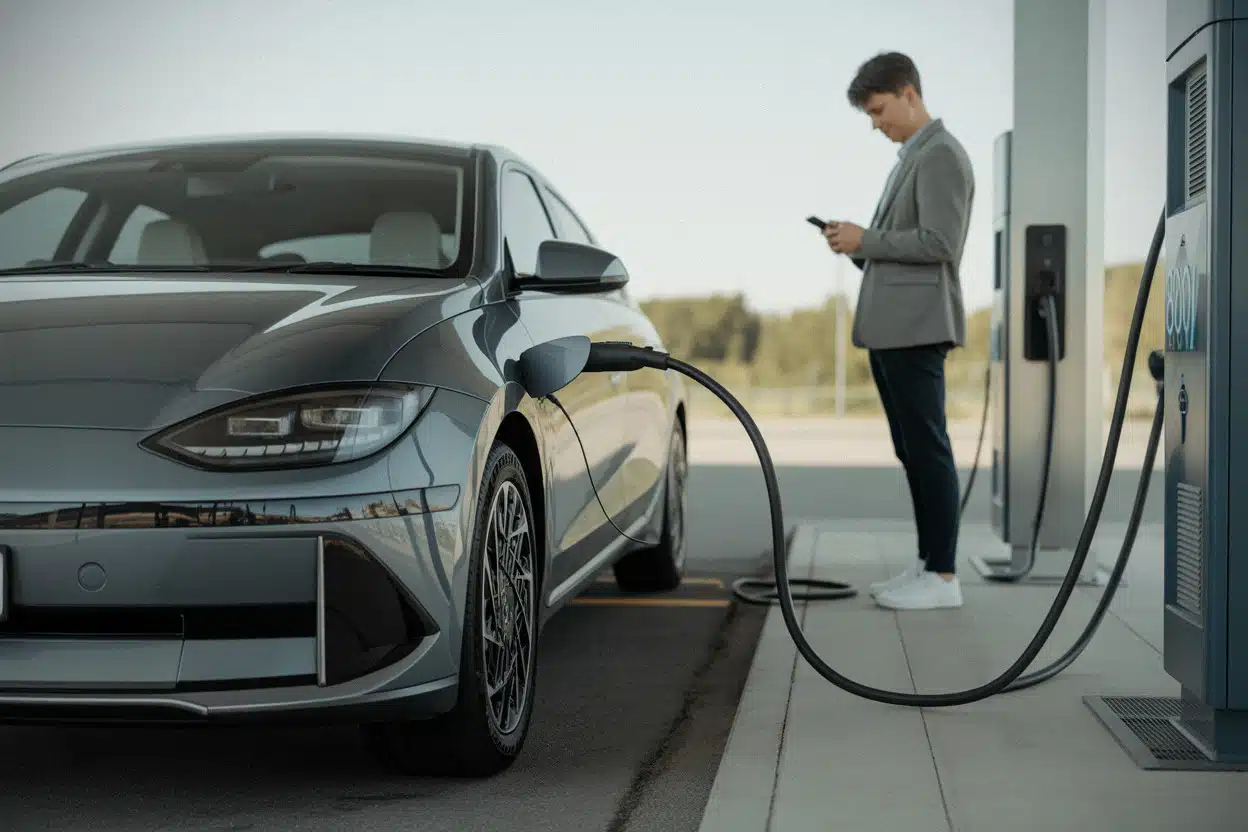
Hyundai-Kia’s 800-volt platform keeps the Ioniq 6 near the top of fast-stop rankings
Vehicles from the Hyundai-Kia group are frequently cited as standouts for range recovery during very short charging stops, largely thanks to their 800-volt architecture. In the front pack, the Hyundai Ioniq 6 is often treated as a textbook example—its aerodynamic shape and charging management helping it turn energy added into usable highway miles quickly.
Information circulated in the specialized press suggests the Ioniq 6 can rank very high on the “range in 10 minutes” metric, with one estimate cited around 435 km (about 270 miles) in some readings. That figure should be read as an indicator of fast-charging performance and efficiency—not as a guarantee of identical “added range” in every real-world scenario, since consumption can vary sharply between city and highway driving.
The 800-volt advantage shows up most in stability: the car can sustain high power longer than a model whose charging power drops quickly. For drivers, that can mean a shorter stop to hit the same distance target. Over a long trip, the benefit can add up—minutes saved at each stop, and sometimes one fewer stop in a day, depending on charger density.
The tradeoff is that this performance depends more heavily on access to very powerful chargers. An 800-volt EV performs best at well-built HPC sites. At lower-powered stations, the advantage shrinks because everyone is capped by the charger, and differences shift back toward efficiency—who uses less energy to cover the same distance.
In 2026, another key question is repeatability. On summer highway travel, thermal management needs to support multiple fast-charging sessions without a major drop in power. Cooling systems, preconditioning, and battery sizing help explain why two cars with similar paper specs can deliver different 10-minute results.
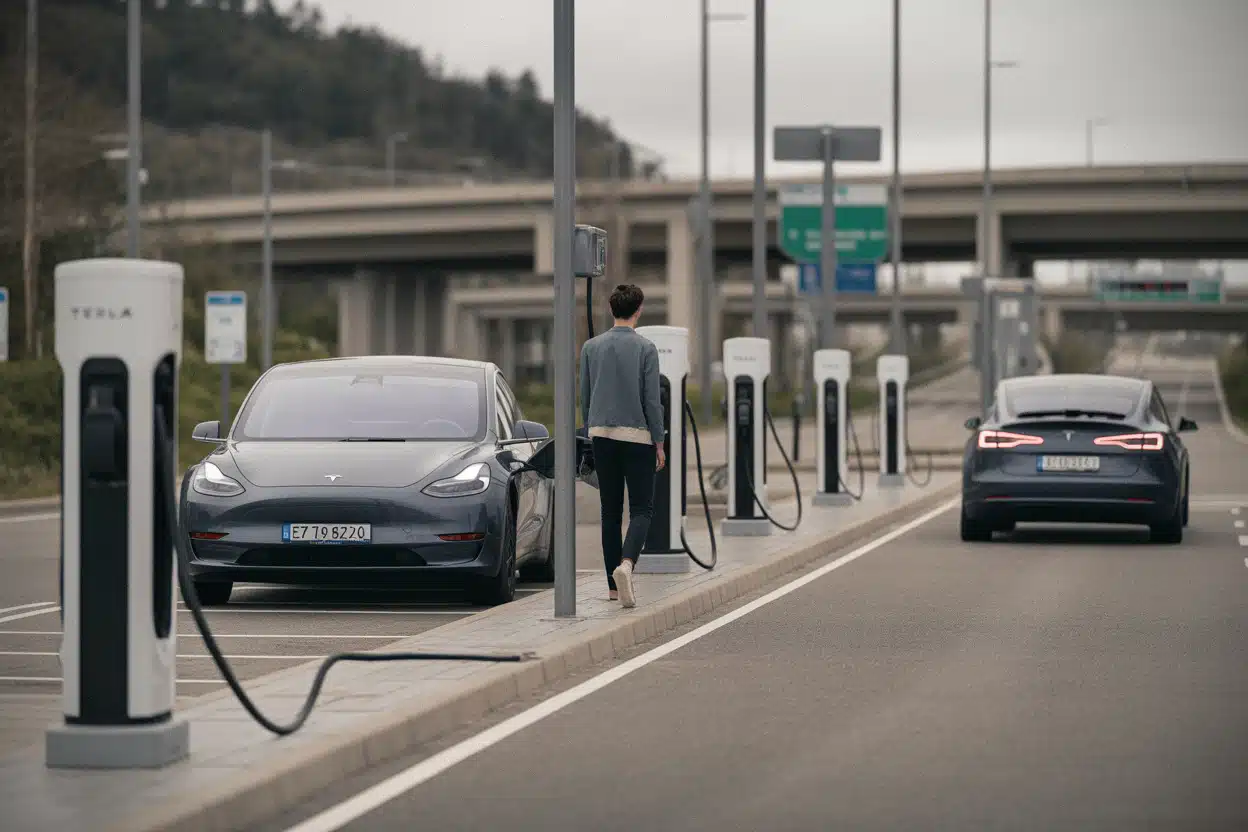
Tesla leans on the Supercharger ecosystem for predictable stops, not just peak speed
At Tesla, the fast-charging fight isn’t only about a maximum number. It’s about the full package: the vehicle, trip planning, and network availability. In 2026, the Supercharger ecosystem remains a major selling point for long-distance travel because it reduces uncertainty—reliable locations, navigation integration, stop-time estimates, and automatic battery preconditioning.
In “10-minute” comparisons, some models may post very high short-window gains, but Tesla’s experience often stands out for consistency: predictable stops and software-optimized charging management. The useful performance is the one that repeats from station to station—without hunting for a specific charger, worrying about insufficient power, or dealing with complicated billing. For many drivers, that can matter as much as a few extra miles gained in a single stop.
“Range regained” also depends on efficiency. A more efficient vehicle turns each kilowatt-hour into more miles. Tesla has long emphasized aerodynamics and motor management, which can make charging minutes pay off in miles—especially at steady speeds. In practice, the gap often comes down to sustained charging power versus real consumption on the next leg.
The industrial context is tightening the race. Competition is intense, particularly with BYD’s rise in global volume. Market figures circulated online put BYD at 2,256,714 sales of fully electric vehicles, ahead of Tesla with 1,636,129 deliveries over a reference period presented as annual. That ranking is fueling a charging arms race, because selling an EV increasingly depends on how easy it is to travel long distances.
Against that backdrop, Tesla is pushing on two fronts: improving vehicles while also expanding and opening access to charging. On highway corridors, the visible difference isn’t only power—it’s the ability to get back on the road quickly without detours. The “10-minute” metric becomes one part of a door-to-door travel experience measured in total time.
BYD is expanding in Europe, but real-world results hinge on the car-and-charger pairing
BYD has become a central player in 2026, driven by both volume and an expanding lineup in France, including models such as the Dolphin, Atto 3, Seal, Seal U, and Han. In fast charging, the challenge is twofold: offering vehicles that can take advantage of HPC stations and convincing buyers that the road-trip experience matches established European and American benchmarks.
The same global sales figures cited in online analyses—2,256,714 BEVs for BYD versus 1,636,129 deliveries for Tesla—show industrial momentum, but they don’t settle the “miles in 10 minutes” question for everyday drivers. What matters day to day is the combination of a model’s charging capability, how stable its power delivery is, and access to high-performing chargers on heavily traveled routes.
Here, BYD faces the same constraint as most brands outside Tesla: reliance on multiple charging networks with varying maintenance, power levels, and pricing. A vehicle that looks strong on paper can lose its edge if the charger is capped, if power is shared, or if thermal conditions limit charging. The issue becomes especially sensitive during peak travel periods, when crowds reduce availability.
Price remains a lever. Pricing analyses mention BYD entry models under €30,000 (about $32,400), while a Tesla is often described as starting around €40,000 (about $43,200) depending on configuration and timing. That gap draws new buyers to BYD, but it also raises expectations around charging—drivers want an affordable car that doesn’t stretch travel times.
In the near term, the clearest approach is to avoid broad generalizations and evaluate model by model. “10-minute” performance isn’t uniform across a lineup; it depends on the battery, power electronics, and software calibration. For shoppers, the key data is average power sustained over those 10 minutes—and how the car behaves between 10% and 60%, the window that shapes most highway charging stops.
WLTP range and 10-minute charging speed produce different winners in 2026
In 2026, rankings for “best range” and “best range recovered in 10 minutes” often crown different vehicles. Lists of long-range models published on specialized sites cite vehicles such as the Tesla Model S Long Range, some large premium SUVs, and highly efficient sedans. Their strength is spacing out stops—not necessarily charging the fastest in a short window.
Advertised range is based on the WLTP cycle. It’s useful for comparisons, but it can diverge from high-speed highway driving. On long trips, that gap makes “miles regained in 10 minutes” more valuable because it better reflects the reality of a coffee break. A car can look great on WLTP yet be held back by a less aggressive charging curve or weaker efficiency at 130 km/h (about 81 mph).
Another common misunderstanding is the conversion from energy to miles. Two cars that add the same amount of energy in kWh won’t necessarily add the same distance. The more efficient car will show more “miles gained.” That’s one reason aerodynamic sedans and highway-optimized models tend to score well in 10-minute rankings even if they don’t have the biggest battery.
For decision-making, the most solid approach is to combine three indicators: realistic highway range, average charging power over 10 minutes between 10% and 30%, and total time to go from 10% to 80%. Together, those metrics describe vacation-style highway use better than any isolated peak number—and they help compare different philosophies: a big battery with fewer stops versus a smaller battery with very fast charging.
As infrastructure improves in 2026, these differences become more visible. When HPC stations are available, vehicles that can sustain high power save time. When stations are crowded or limited, efficiency and baseline range matter more because they reduce dependence on the charger. That’s why, depending on the route, the “10-minute champion” isn’t always the car that delivers the shortest overall trip.
Frequently asked questions
Why isn’t maximum power (kW) enough to judge 10-minute charging? Because a car only hits peak power briefly. Distance regained depends on average power over 10 minutes, battery temperature, starting charge level, and charger limits.
Does 800-volt tech always guarantee the best charging? No. 800V can help sustain high power, but the gain depends on access to suitable HPC chargers, battery cooling, and software. On a limited charger, the advantage shrinks.
Should you choose a car with high WLTP range or one that charges fast? It depends on your driving. More WLTP range spaces out stops; faster charging shortens each stop. For highway travel, look at real range, 10–80% time, and miles regained in 10 minutes between 10% and 30%.
What most influences miles regained in 10 minutes? Starting state of charge, the model’s charging curve, highway efficiency, the power actually delivered by the charger, and thermal preconditioning before arrival.
Key takeaways
Range regained in 10 minutes depends more on the charging curve than a headline peak kW figure. Hyundai-Kia’s 800-volt architecture often favors very fast stops, Tesla emphasizes predictable charging through its Supercharger ecosystem, and BYD’s real-world results vary by model and charger. WLTP range and 10-minute charging speed frequently produce different “winners.”
Sources
Tesla, BYD, Hyundai… quelle voiture électrique récupère …; Top 10 des voitures électriques à la plus grande autonomie 2026; Top 10 : les véhicules électriques avec la meilleure …; Instagram reel; Tesla vs BYD 2026 : 2,26M vs 1,64M Ventes BEV [Testé]
Key Takeaways
- The 10-minute recharge depends mainly on the charging curve, not the peak kW figure.
- The 800V architecture, common at Hyundai-Kia, enables very fast charging.
- Tesla leverages the consistency of the Supercharger network and integrated trip planning.
- BYD is gaining ground in the market, but real-world performance varies by model and charger.
- WLTP range and charging speed often produce different rankings.
Frequently Asked Questions
Why isn’t peak power (kW) enough to judge 10-minute charging performance?
Because the car only reaches its peak power for a short time. The miles regained depend mainly on the average power sustained over ten minutes, battery temperature, starting state of charge, and the charger’s limits.
Does 800 volts always guarantee the best charging?
No. An 800V system makes it easier to sustain high power, but the benefit depends on access to compatible HPC fast chargers, battery cooling, and software. On a power-limited charger, the advantage is greatly reduced.
Should you choose a car with long WLTP range or one that charges fast?
It depends on your driving profile. Longer range means fewer stops, while very fast charging shortens each break. For highway driving, it helps to look at real-world range, 10–80% time, and miles regained in 10 minutes between 10% and 30%.
Which factors most affect miles regained in 10 minutes?
Starting state of charge, the model’s charging curve, highway efficiency, the power the charger actually delivers, and thermal preconditioning of the battery before arriving at the station.