
After severe flooding in China, videos carried by local media have shown residents clustering around electric vehicles to recharge phones, lamps and other small devices. In those moments, the car stops being just transportation and becomes a backup power source—thanks to external power features built into a growing number of EVs.
The ad-hoc charging stations, sometimes spontaneous and sometimes organized at the neighborhood level, spotlight a real-world use for EV batteries during a crisis. They also raise questions about electrical safety in wet conditions, technical standards and how prepared local power systems are for prolonged outages.
Flood-hit neighborhoods turn EVs into improvised charging stations
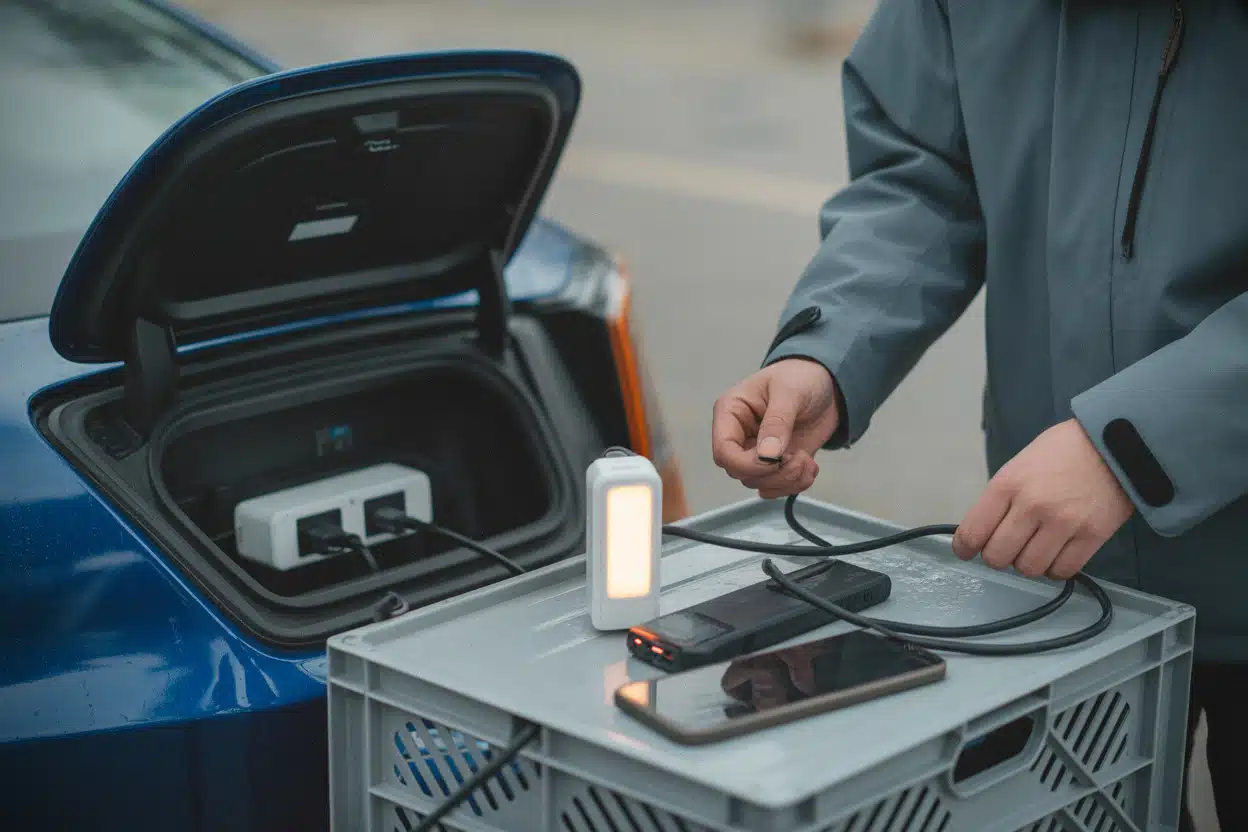
In several cities affected by flooding, images shared in China show neighbors gathering around an EV, power strip in hand, to grab a few hours of electricity. The move is simple—plug a smartphone charger or a lamp into an onboard outlet—but it signals a shift in how people use these vehicles.
When outages drag on, an EV can become an immediately available energy reserve, without waiting for the grid to come back or for a generator to arrive.
The setup relies on V2L (Vehicle-to-Load), a feature offered on an increasing number of models. It lets drivers power external devices through a dedicated outlet, with limited output but enough for essentials such as smartphones, power banks, radios, fans, LED lighting or small medical equipment.
In the scenes being shared, the goal isn’t to keep an entire home running for days. It’s to preserve basic communication and light—two critical needs during evacuations or periods of uncertainty.
In these situations, the car can also become a meeting point. When mobile networks are overloaded or residents are searching for reliable information, the ability to recharge a phone becomes a frontline necessity. The vehicle’s social role is clear: the battery isn’t only helping the owner, it’s helping a group.
That kind of sharing is made easier by China’s large EV fleet and the spread of models equipped with a 220-volt outlet or an external power adapter.
This kind of use has been seen in other disaster-prone regions, but the scale observed in China reflects a mix of factors: a very large number of vehicles, familiarity with household electrical gear, and the rapid spread of practices through social media. The improvised line around a car is a reminder that energy resilience often depends on what’s immediately available—even if it’s limited in power and duration.
Denza (BYD) owners cited as providing backup power in flooded areas
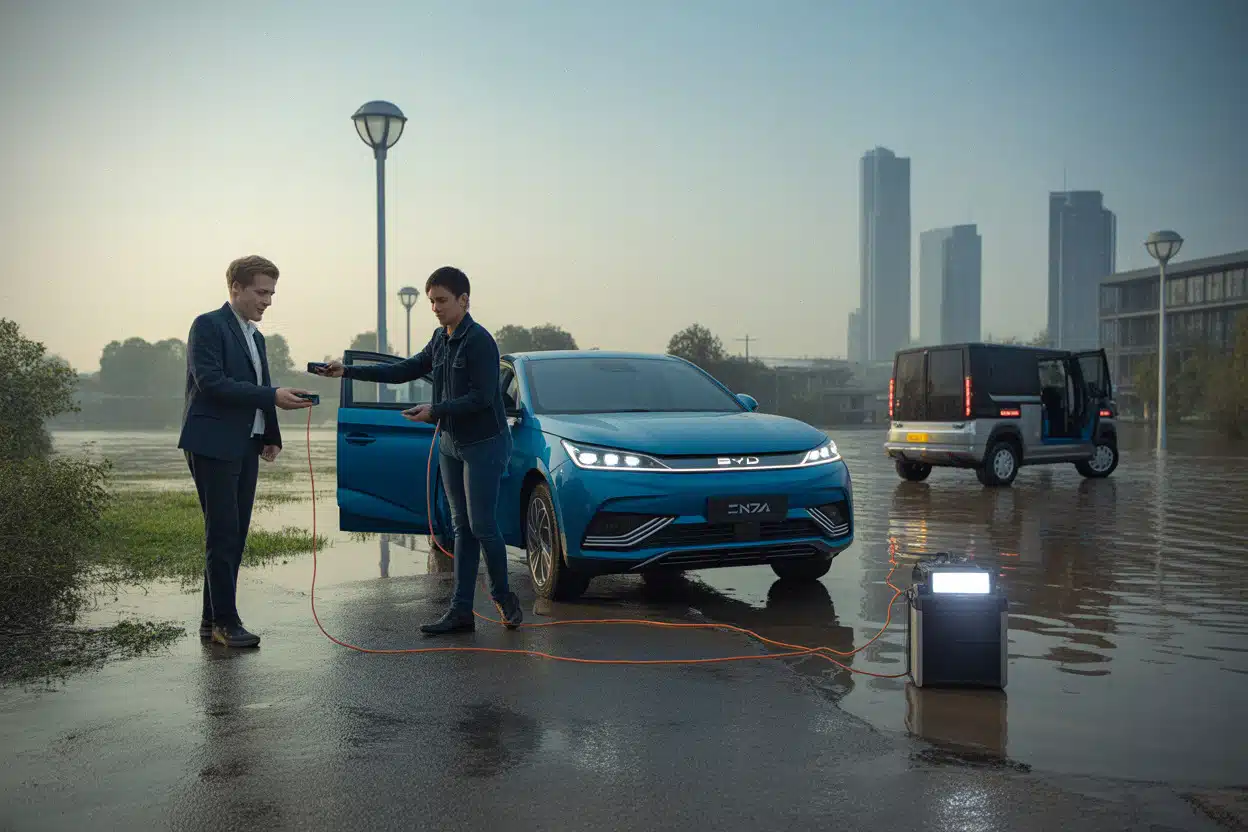
Accounts and posts being circulated specifically mention owners of Denza vehicles—a brand associated with BYD—using their cars to help in affected areas. In these episodes, assistance isn’t limited to transport or evacuation; it can also include providing electricity for short-term needs, including phone charging, temporary lighting, or running basic devices where the grid is down.
Some drivers choosing to stay put to supply power isn’t a trivial decision. It requires estimating remaining range, managing the battery to avoid getting stranded, and having at least a basic understanding of the outlet’s maximum output.
In practice, the use tends to focus on low-consumption devices, which helps extend how long the car can provide service. An EV battery holds substantial energy, but external power is constrained by output limits and electronic protections.
The Denza examples also highlight the limits of emergency help built on individual initiative. Not everyone has a compatible vehicle, the right cable, or a safe place to park away from floodwater. In inundated environments, parking, access and keeping distance from submerged areas become major constraints.
The images often show vehicles stopped on still-passable stretches of road, which reduces water-related risks—but doesn’t eliminate them.
More broadly, the Denza case underscores that the value of a large EV fleet isn’t measured only in miles driven or market share. It can also be measured in how much support it can provide during a local crisis when the power network is fragile. From a civil-protection perspective, that capacity could be strengthened with practical guides, standardized connection points and clear instructions to avoid dangerous improvisation and overloads.
Electrical safety becomes the central concern: water, short circuits and fire risk
When a car is supplying electricity in the middle of a disaster, safety quickly becomes the overriding issue. Flooding brings moisture, mud, damaged equipment and sometimes compromised household wiring. Plugging a power strip or charger into a soaked environment can be enough to trigger an accident.
Automakers build in protections, but those don’t replace careful use—keeping connections away from water and using equipment that’s in good condition.
Chinese authorities have been working for several years on stronger battery safety requirements. Recent texts and industry discussions aim to reduce the risk of fire, including in the event of major failure, with stricter criteria for thermal management, runaway prevention and crash resistance.
That direction affects battery design, cutoff devices and monitoring software. In a flood scenario, those measures matter because water and debris can cause faults, even if modern vehicles are designed to withstand rain and road spray.
The most sensitive point remains the boundary between the vehicle and its surroundings: outlets, adapters, extension cords and the devices being powered. V2L turns the car into an electrical source—and therefore a potential liability. If a faulty device overheats or an extension cord is damaged, the risk isn’t limited to the user; it extends to everyone gathered nearby.
Collective charging scenes, however helpful, require basic organization: a dry location, cables kept out of walkways, and limits on how many devices are connected at once.
Battery management is another challenge. In disaster zones, access to charging stations can be disrupted, making it important to keep enough energy in reserve to move or reach safety. Providing power for hours can sharply reduce remaining range.
That makes an EV a useful emergency tool, but not a full replacement for structured backup power. For households, portable power stations or home systems can complement what a vehicle can provide.
V2L vs. V2G: immediate neighborhood power is easier than feeding the grid
The flooding episode also highlights a key difference between V2L and V2G (Vehicle-to-Grid). V2L powers devices directly. V2G sends electricity back into the grid, which requires infrastructure, metering, billing rules and technical compatibility.
The images circulating from China reflect a close-range, immediate approach with no intermediary—often the only realistic short-term option for a neighborhood without power.
For grid operators and local authorities, the scenes function as a demonstration: a mobile battery can support critical uses, at least partially. In dense urban areas with high EV adoption, the idea of a distributed reserve becomes more plausible.
But it still requires oversight—such as secure connection points at shelters, procedures to prevent conflicts over use, and guidance to preserve the range of vehicles being tapped for power.
Deployment also varies by model and brand. Some vehicles include an outlet inside the cabin or trunk; others require an adapter. Available output differs, too, shaping what can be powered. Limited output works for phones and lighting, but not for high-demand equipment like cooktops or some heating devices.
In a crisis, that distinction matters: it can determine whether people can only stay connected—or also maintain a basic level of comfort.
The floods are also a reminder that resilience doesn’t hinge on a single technology. EVs can complement existing options—generators, stationary batteries and microgrids—but they don’t replace planning. For manufacturers, the moment highlights features already built into vehicles. For public officials, the challenge is integrating those capabilities into realistic emergency scenarios with simple rules and clear public guidance so emergency use stays effective and safe.
Key Takeaways
- After the floods, electric cars were used as nearby sources of electricity.
- The V2L feature can recharge smartphones, lamps, and small devices in just a few minutes.
- Denza owners, a brand affiliated with BYD, were mentioned in local mutual-aid efforts.
- Cable and connection safety remains a major concern in wet environments.
- V2G interests power grids, but its rollout is slower and more tightly regulated.
Frequently Asked Questions
What is V2L on an electric car?
V2L, or Vehicle-to-Load, lets an electric car power external devices through a dedicated outlet or an adapter. The output is limited, but it’s usually enough to charge phones, run LED lights, a radio, or other small equipment.
Can an electric car power an entire house during an outage?
With V2L, the goal is mainly to power essential devices, not to fully replace household grid power. Powering a whole home requires higher output and a suitable installation. In some cases, V2H or V2G solutions exist, but they require specific equipment and a regulatory framework.
What are the risks of using V2L during a flood?
The main risk comes from the environment—water, mud, damaged extension cords, and power strips on the ground. Set up connections in a dry area, limit the number of devices, watch for overheating, and avoid any contact between cables and water, even if the vehicle has electronic protections.
Is V2G already common in China?
V2G is growing, but it’s still more complex than V2L. It requires bidirectional chargers, metering and compensation rules, and vehicle-to-grid compatibility. In reported emergency situations, the use observed is mostly V2L, which is more immediately practical.