

Accor says business travel is being rebuilt in real time—and hotels that want to keep corporate demand will have to make faster, clearer trade-offs in 2026. After discussions with industry players, the French hotel group is pointing to a set of shifts it believes will support hotel performance in coming quarters, even as companies scrutinize travel budgets and weigh in-person trips against remote work.
For Accor, this isn’t a branding exercise. The changes hit the nuts and bolts of corporate travel: expense reporting, travel policies, sleep quality, data security, and whether rooms are actually available near major business districts. At the same time, hotels are being asked to deliver a consistent experience with teams under staffing pressure and guests expecting smoother service.
The core challenge, Accor argues, is raising the value of a stay without automatically raising operating costs—by making targeted investments, using data more effectively, and sharpening what hotels offer both travelers and corporate travel managers.
Accor bets on AI to personalize business stays—without slowing the basics
Business hotels have long sold reliability: fast check-in, a ready room, an accurate invoice, stable Wi-Fi, and breakfast available early. In 2026, Accor is tying that “no surprises” promise to more precise personalization, driven by artificial intelligence and more unified customer-relationship tools.
The goal is to recognize repeat guests, understand preferences, and surface the right service at the right moment—without adding friction. Accor frames that as a win not only for the traveler but also for the travel manager, who wants standardization and fewer billing disputes.
In practical terms, Accor presents AI as an efficiency lever first—handling repetitive tasks such as confirmations, simple requests, pre-registration, and practical information. The point, it says, is not to replace human hospitality but to free staff for higher-value interactions: handling disruptions, special requests, or supporting groups.
Accor says personalization can show up in room choices, departure times, dining options, or services aligned with meeting-heavy schedules. The payoff is meant to be fewer pain points—less waiting, fewer back-and-forth exchanges, and a stronger sense of value for money.
That shift also raises the stakes on data governance. Hotels collect sensitive information—identity details, contact information, preferences, and payment elements. For corporate clients, internal compliance and cybersecurity requirements add another layer. Accor notes that AI tools such as chatbots and automations need clear rules on consent and data retention, and must avoid costly errors like misattributing a preference or making an unsuitable offer.
At the scale of a global group, another challenge is consistency: delivering a uniform experience across brands, countries, and booking channels.
Accor also links personalization to revenue management. A hotel can optimize inventory without degrading the guest experience by steering certain profiles toward relevant offers or services. The upside is twofold: a higher average spend on useful add-ons and improved satisfaction that increases the likelihood of return.
In business travel, Accor argues, value often comes down to repeat stays and the details—an accurate invoice, quiet rooms, an accessible gym, and a functional workspace. The challenge is turning those basics into visible advantages using tools that stay in the background.
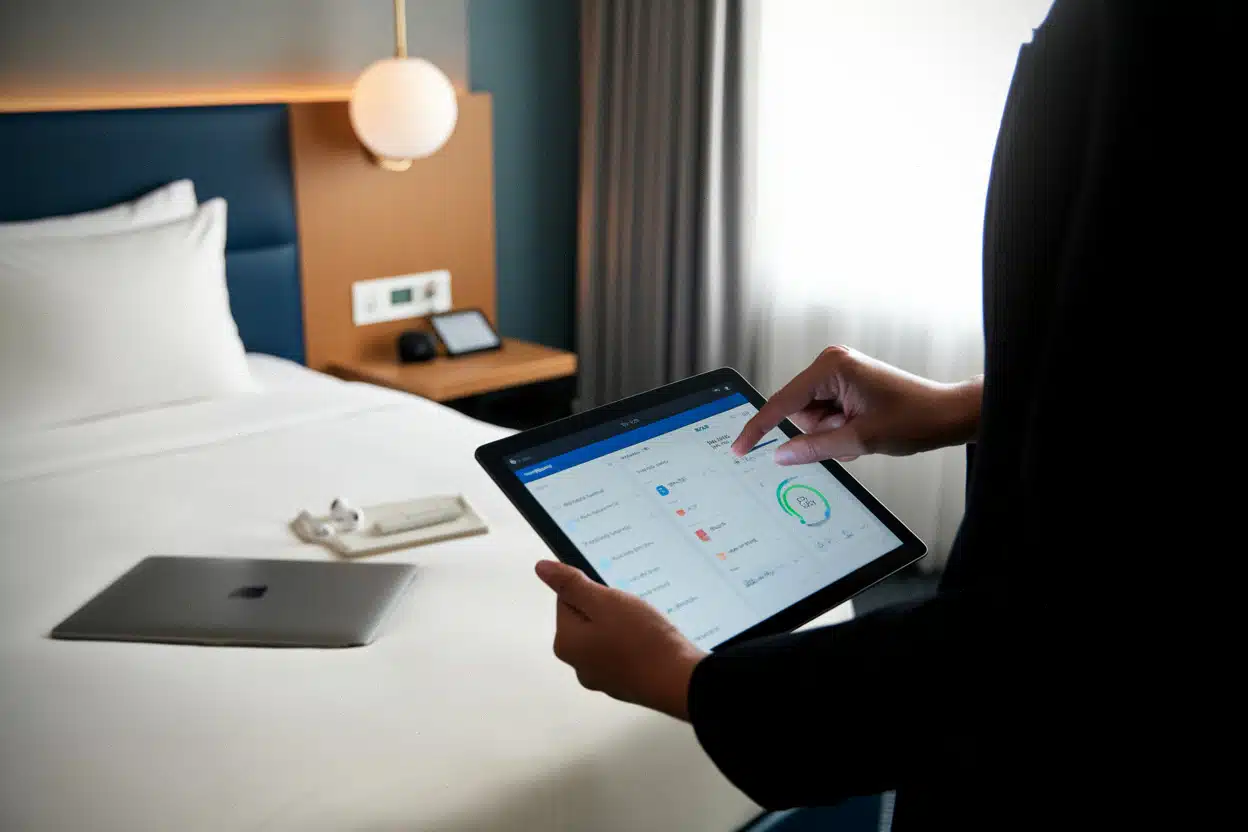
“Bleisure” moves from perk to policy problem for corporate travel
Accor identifies “bleisure”—extending a work trip with leisure time—as a durable driver reshaping demand. The shift shows up in more flexible, sometimes longer stays, with arrivals the night before or departures pushed back.
For hotels, Accor says, that changes the product. It’s no longer just a functional room near an office. Properties are expected to work for both work time and recovery time. In 2026, Accor says that expectation affects design choices, service hours, and how hotels connect to the urban neighborhoods around them.
For employers, bleisure creates rule-setting headaches. Travel policies have to spell out what the company covers, what the employee pays, and how to separate a business night from a personal extension. Accor says travel managers want clear documentation, segmented invoices, and easy-to-understand cancellation terms—and corporate booking platforms favor offers that reduce ambiguity.
Hotels that make the split easier—by separating folios or simplifying changes—can reduce friction and become more attractive to corporate decision-makers, Accor argues.
On the traveler side, Accor says demand is clustering around hybrid services: comfortable daytime workspaces and strong soundproofing, paired with end-of-day amenities such as gyms, spa access, and flexible dining. Guests also care about what’s outside the front door—transit access, lively neighborhoods, safety, and proximity to cultural sites.
Accor suggests hotels that can combine those elements can win travelers who no longer want a standardized property. Brands that deliver a credible local experience without losing the service level expected by corporate clients are better positioned when companies compare options.
The shift also forces a commercial rethink. Accor says hotels need to adjust packages, add weekend options, highlight local partnerships, and craft sales messaging that speaks both to corporate buyers and to travelers. The risk is mixed signals: a leisure-heavy pitch can worry some corporate accounts, while a purely corporate pitch can miss the added value of an extended stay.
Performance also hinges on occupancy—filling Friday-to-Sunday nights in hotels traditionally built around weekday demand. For Accor, bleisure becomes a balancing point between business volumes and incremental revenue.

Energy “sobriety” and ESG proof start showing up in corporate hotel contracts
Accor says corporate ESG commitments—often referred to in France as “RSE,” for corporate social responsibility—are increasingly turning into purchasing requirements. In business hotels, that means sustainability is moving beyond messaging and into RFPs, compliance questionnaires, and supplier audits.
In 2026, Accor says large corporate accounts are asking for concrete evidence: energy consumption, water management, waste policies, cleaning products, laundry practices, and sometimes an estimated carbon footprint for a stay. Hotels, in turn, need to document those points with reliable, comparable data.
Accor also describes “sobriety” as part of the guest experience. Customers may accept certain measures—like changing sheets on request, limiting plastics, or optimizing lighting—when they’re coherent and clearly explained. But comfort still sets the limit: a poorly heated room or a degraded breakfast gets punished.
That forces hotels to balance lower consumption with service standards, often through investments in building systems: sensors, regulation, renovations, and equipment choices. Accor notes the return on investment depends on energy prices, occupancy levels, and whether hotels can translate those efforts into commercial value.
For companies, Accor says the tension is real: a highly sustainable hotel that’s poorly located can increase transport time, cost, and fatigue. Procurement teams look for measurable compromises—location, price, flexibility, and ESG proof. Hotel groups that standardize reporting and provide usable documentation can save time in negotiations.
That dynamic favors networks with broad coverage, Accor argues, because they allow companies to apply a consistent policy across multiple cities.
Accor also frames sustainability as a competitive arena. Independent hotels can stand out with strong local approaches—short supply chains or low-carbon renovations—but still have to prove results. Large groups have reporting tools and structured programs, but face unevenness across their portfolios.
Accor’s message: sustainability has to be integrated into the business model, not treated as a forced expense. Business travelers, it adds, are paying closer attention—especially when their employers have public climate targets and expect aligned behavior.
Accor’s growth push: 48 hotels opened in Q1 2026
Accor ties these demand shifts to its network strategy. The company reported solid activity in the first quarter of 2026, opening 48 hotels and adding more than 6,700 rooms—net network growth of 3.8%.
The pace signals a bet on recovery and changing travel flows, including in the business segment, which is closely tied to economic conditions and corporate travel budgets. Expanding the footprint is also meant to strengthen presence in markets where companies want standardized, easy-to-access options.
Location remains decisive for business travel—near train stations, airports, office districts, and city centers that host trade shows and events. A larger network can cover more “landing spots” and better match corporate travel policies that favor approved hotels for compliance, negotiated rates, and security reasons.
But Accor also points to the coherence problem: maintaining consistent service while multiplying addresses, training teams to shared standards while leaving room for local adaptation.
The expansion comes as the hotel industry faces employment pressures. New openings require hiring, training, and operations capable of absorbing demand spikes from conventions, major events, and peak periods. For business travelers, quality is often judged by consistency—welcome, cleanliness, speed, and the ability to fix an evening problem quickly.
Accor argues growth is an advantage only if it’s paired with stronger skills and solid operational tools. Otherwise, service gaps can show up in online ratings and corporate satisfaction.
Looking across 2026, Accor says expansion intersects with the other trends it highlights: digitization, personalization, and ESG reporting. A bigger network generates more data, which can improve customer knowledge if properly consolidated—but it can also increase fragmentation risks, with different systems, varied practices, and uneven data quality.
The challenge for Accor and competitors, the company suggests, is turning scale into something corporate clients can feel: more availability, more stable negotiated terms, and a more predictable experience—even when a traveler changes cities multiple times in a month.
Frequently asked questions
What trends is Accor highlighting for business hotels in 2026?
Accor points to the rise of AI to automate tasks and personalize stays, the growth of bleisure, and the increasing weight of ESG/RSE criteria and energy sobriety in corporate purchasing decisions.
Why does bleisure complicate business travel management?
Because it requires separating the business portion from the personal portion of a trip—on billing, covered nights, insurance, and internal rules. Companies want clear documentation and simple processes, such as segmented invoices.
How does AI change the guest experience in a business hotel?
Accor says it can speed up transactional steps like confirmations and simple requests, and help propose relevant options—room, timing, services. The key is reliability: personalization should reduce friction without degrading human hospitality.
What ESG/RSE elements are companies asking hotels to provide in 2026?
Accor says requests focus on measurable proof: energy use, water management, waste reduction, laundry policies, and the ability to provide comparable data in RFPs and supplier questionnaires.
What does Accor opening 48 hotels in Q1 2026 mean for business travel?
Accor frames it as an expansion strategy to strengthen geographic coverage and availability—important for corporate travel policies. Success depends on maintaining consistent quality and operational standards.
Key takeaways
- Accor links 2026 business-hotel strategy to AI-driven personalization and smoother service
- Bleisure is becoming central to travel policies and billing clarity
- ESG/RSE and energy sobriety are weighing more heavily in corporate RFPs
- Accor accelerated development, opening 48 hotels in Q1 2026
- Accor identifie les grandes tendances de l'hôtellerie d' …
- Accor identifie les grandes tendances de l'hôtellerie d' …
- 4 Tendances Hôtellerie 2026 | Analyse Sectorielle | ADT
- Blog Oversight – 5 grandes tendances qui redessinent l’hôtellerie en 2026
- Chiffre d'affaires du T1 2026 : Une activité solide dans un …
Sources
Key Takeaways
- Accor links business hospitality in 2026 to AI and personalized service
- Bleisure becomes a central factor in travel policies and billing
- ESG criteria and energy efficiency carry more weight in RFPs
- Accor accelerates its growth, with 48 hotels opened in Q1 2026
Frequently Asked Questions
What trends is Accor highlighting for business travel hospitality in 2026?
Accor points in particular to the rise of artificial intelligence to automate tasks and personalize the stay, the growth of bleisure, and the increasing importance of ESG criteria and energy efficiency in companies’ purchasing decisions.
Why does bleisure make managing business travel more complicated?
Because it requires separating the business portion from the personal portion of the stay—for billing, covered nights, insurance, and internal policies. Companies expect hotels to provide clear documentation and simple processes, such as split invoices.
How is AI changing the guest experience in a business hotel?
It can speed up transactional steps, such as confirmations or certain simple requests, and help suggest suitable options—room, timing, services. The key is reliability: personalization should reduce friction without diminishing the human welcome.
What ESG elements are companies asking hotels for in 2026?
Requests focus on measurable proof: energy use, water management, waste reduction, laundry policies, and the ability to provide comparable data in RFPs and supplier questionnaires.
What does the opening of 48 Accor hotels in Q1 2026 mean for the business segment?
It signals an expansion strategy aimed at strengthening geographic coverage and availability—an important factor for corporate travel policies. Success then depends on the ability to maintain consistent quality and operational standards.
Sources
- Accor identifie les grandes tendances de l'hôtellerie d' …
- Accor identifie les grandes tendances de l'hôtellerie d' …
- 4 Tendances Hôtellerie 2026 | Analyse Sectorielle | ADT
- Blog Oversight – 5 grandes tendances qui redessinent l’hôtellerie en 2026
- Chiffre d'affaires du T1 2026 : Une activité solide dans un …



