

GENEVA — The World Youth Forum (WYF) on July 10, 2026, unveiled a new “Global AI Talent Compact” at the AI for Good 2026 summit in Geneva, pitching it as an open action network meant to speed the development of job-ready artificial intelligence talent.
The launch lands as employers describe a widening gap between the explosion of AI use and the ability of education systems—and then companies—to train, qualify, and hire people who can actually deliver in real-world conditions. Recruiters, the WYF argues, are increasingly facing a paradox: a flood of resumes that mention AI, and a shortage of concrete proof—projects, technical contributions, portfolios, and on-the-ground experience—that demonstrates mastery of data constraints, security, compliance, and maintenance.
Beyond tools, the Compact emphasizes AI literacy, “human capabilities” needed in the AI era, project-based learning, protecting young people’s well-being, and recognizing ability through evidence of real work rather than degrees alone—raising a pointed question for employers: how do you select and grow talent when traditional signals like job titles, diplomas, and years of experience are being reshaped by models, copilots, and automation?
Five commitments, launched on a UN platform for practical AI
In a statement dated July 10, 2026, WYF—described as a nonprofit active in more than 30 countries—said it used AI for Good 2026, where it was an official session partner, to formalize the Global AI Talent Compact.
AI for Good is framed by organizers as the United Nations’ reference platform on AI, led by the International Telecommunication Union (ITU) in partnership with more than 50 UN agencies and co-convened with the Swiss government. That setting places the Compact inside a multi-stakeholder ecosystem that includes governments, universities, student communities, and international organizations.
Rather than a centralized program, WYF presents the Compact as an open action network built around five commitments: expanding access to AI literacy; defining the key “human capabilities” for the AI era; rolling out challenge- and project-based learning; protecting young people’s well-being; and recognizing aptitude through evidence of real work rather than degrees alone.
The approach is aimed at two recurring labor-market problems highlighted in the announcement: confusion between familiarity with consumer AI tools and professional competence, and the difficulty of evaluating candidates using comparable criteria.
WYF also pointed to a roster of supporters that signals an attempt to align training, standards, and real-world needs. The statement cites participants from AI Singapore, the ASEAN Foundation, the International Trade Centre (ITC), UNRISD, and the United Nations University (UNU), alongside specialized student communities including Imperial AI Group, Oxford Guild, UTMIST at the University of Toronto, and the Global AI Alliance at Penn.
The presence of trade- and development-oriented organizations such as the ITC also points to a broader employability goal beyond major tech capitals. In that framing, AI literacy is not just for future engineers, but also for people expected to work alongside automated systems in marketing, HR, logistics, health care, and public services—suggesting AI skills are becoming a cross-cutting layer rather than a siloed “data team” specialty.
WYF did not publish an execution timeline or public numeric targets for how many people would be trained. But launching inside AI for Good—a summit designed to accelerate practical applications in support of the UN Sustainable Development Goals—puts pressure on the initiative to show demonstrable results. Recruiters, the article notes, are likely to read the message clearly: selection criteria will need to move closer to proof of impact and the ability to deliver under real constraints.
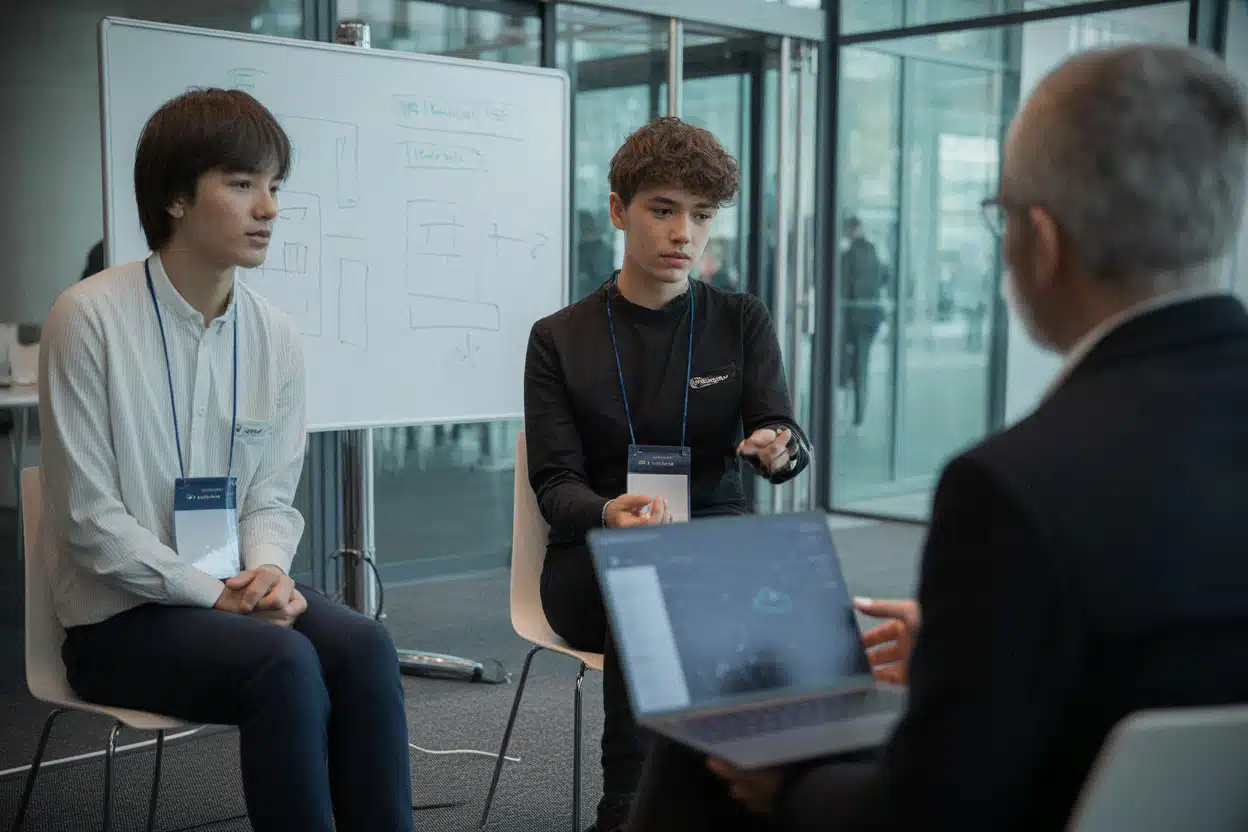
Recruiters face the diploma-vs.-portfolio gap in AI hiring
The Compact’s fifth commitment—recognizing aptitude through evidence of real work—hits a sensitive point for HR teams: the tendency to overvalue titles and the challenge of verifying skill.
In AI roles, resumes can quickly mirror the latest trends—LLMs, prompting, MLOps, RAG—while concrete deliverables vary widely. For recruiters, the problem is not spotting keywords; it’s assessing whether a candidate can produce a robust, documented, testable, maintainable system while meeting confidentiality requirements and data-governance constraints.
By promoting challenge- and project-based learning, the Compact effectively elevates the portfolio model. In practice, that pushes employers to ask for verifiable artifacts: code repositories, experiment logs, test suites, decision records, error analyses, or demonstrations of how a system integrates into a product. For nontechnical roles, “proof” may look different—documented use cases, quality-control procedures, risk matrices, or change-management materials. Companies that keep hiring based on degrees alone, the article argues, risk performance gaps when systems move into production.
A second trap is the blurred line between using tools and understanding fundamentals. Copilots can speed up content, scripts, or prototypes, but they can also hide weaknesses—an inability to diagnose data drift, interpret a metric, secure an API, or manage rights tied to training data. The Compact’s emphasis on “human capabilities” translates, in recruiting terms, into measurable behaviors: validation rigor, critical thinking, the ability to collaborate with legal and security teams, and the skill to explain limitations to decision-makers.
In a global market, evaluation is also an equity issue. Recognizing candidates through proof of work can open doors for applicants from less well-known countries or institutions—if recruiters adapt their processes with standardized exercises, comparable case studies, structured interviews, and shared scoring rubrics. Otherwise, the article warns, employers may simply replace one bias (degree prestige) with another (the ability to stage a project without real technical depth).
That shift carries operational costs. Reviewing portfolios and auditing projects takes more time than filtering by degrees. Some companies respond with in-house tests; others with strengthened trial periods or short missions. WYF’s Compact, the article suggests, legitimizes that direction: value is measured in production and the ability to learn fast. For candidates, the implication is blunt—credible AI training will increasingly need to produce work traces, not just certificates.

AI for Good ties the Compact to ITU priorities on trust, safety, and inclusion
Organizers describe AI for Good 2026, run by the ITU, as a place to connect AI innovators with public- and private-sector decision-makers to help deploy AI solutions that can be implemented in the short term in support of the Sustainable Development Goals.
That positioning gives WYF’s Compact a specific frame: training can’t stay abstract—it has to produce applicable skills and cross-border collaboration. For recruiters, the UN setting also nudges competency frameworks toward concepts like trust, safety, inclusion, and impact.
AI for Good materials highlight work related to organizational and national “readiness,” along with publications tied to standards and the authenticity of multimedia content. Without diving into technical details, the article’s takeaway is that AI is no longer just about model performance; it increasingly requires governance, standardization, and verification practices. That shift changes the profiles employers need: beyond data scientists, companies are looking for skills in control, audit, risk management, and integration.
The Compact also sits inside a program where youth participation is a central theme, including young-leader communities, challenges, and workshops. For employers, the appeal is twofold: these formats generate time-boxed proof of work—often in teams—making it easier to evaluate behavior and delivery. They also create international networks useful for companies seeking people who can collaborate remotely on global products.
The ITU ecosystem raises another question: shared language. Companies use their own rubrics, while multilateral initiatives push for common frameworks. If the Compact helps definitions converge—even at a general level—recruiting could become clearer. If not, candidates may face an inflation of labels and micro-credentials that are hard to compare.
For recruiters, AI for Good functions as a trend barometer. The rise of content authenticity, technical standards, and organizational readiness signals growing demand for people who can secure AI use—not only prototype it. Placed in that context, the WYF Compact could accelerate a shift already underway: hiring will weigh declared knowledge less, and the ability to make systems reliable, responsible, and useful more.
Youth well-being and AI literacy move into the HR playbook
The Compact’s fourth commitment—protecting young people’s well-being—introduces a theme that is rarely central in skills announcements. For employers, it maps onto concrete issues: work intensification, always-on connectivity, delivery pressure, and exposure to repetitive moderation or data-verification tasks. In AI jobs, faster production cycles and expectations of versatility can burn out junior workers quickly. Putting well-being into an international pact amounts to acknowledging that sustainable performance is now a talent-management issue.
It also intersects with retention. Employers invest in upskilling, then watch people leave within months if workload and organization don’t match. The article describes a coherent AI HR policy as combining training, managerial support, and work norms—review time, a right to disconnect, and clarity on responsibility when an automated system makes an error. The Compact doesn’t provide a detailed operational guide, but it elevates the topic in a way that could influence internal discussions, especially in large organizations and public administrations.
The other pillar—expanding AI literacy—targets the entire workforce. Recruiters already see AI competence spreading beyond the data department. Product managers need to understand model limits; lawyers need to grasp data-related risks; customer-service leaders need to anticipate automated assistant errors; managers need to set realistic objectives. AI literacy becomes a cross-functional prerequisite with levels: awareness, guided practice, then expertise.
In hiring, that changes interviews. Companies are beginning to add questions about responsible use, verification, incident management, and communication. Candidates may be evaluated on whether they can explain when not to use a model, how to avoid data leakage, or how to document an automated decision—skills the article frames as “hygiene” rather than pure performance, reflecting AI’s spread into sensitive processes such as HR, health care, finance, and public services.
The Compact also calls for defining the human capabilities that matter most in the AI era. For recruiters, that’s a prompt to formalize skills that are often implicit: structured curiosity, critical thinking, learning ability, and interdisciplinary communication. As assistants accelerate some deliverables, the value of employees shifts toward problem architecture, validation, decision-making, and accountability. Employers that update job descriptions to match those realities, the article argues, will be better positioned to attract versatile talent and reduce costly production failures.
Beyond the announcement, the central question is execution: how to turn commitments into training and hiring practice. Launching the Compact in an international, multi-stakeholder setting suggests pressure for proof of impact—pilot programs, shared frameworks, and bridges between student communities and employers. Recruiters are already watching the direction of travel: degree-only screening is fading, project evidence is rising, and HR policies are being forced to account for both competence and the working conditions that sustain it.
Questions frequently asked
What is the Global AI Talent Compact launched by WYF?
It’s an initiative announced in Geneva on July 10, 2026, by the World Youth Forum during AI for Good 2026. WYF describes it as an open action network built around five commitments: AI literacy, key human capabilities, project-based learning, protecting youth well-being, and recognizing skills through proof of work rather than degrees alone.
Why does this matter to recruiters?
Because it pushes evaluation methods toward verifiable outputs—portfolios, projects, case studies—rather than training titles. In a market where many candidates claim AI skills, employers are looking for proof they can deliver reliable, maintainable systems.
What kinds of proof can AI candidates show in hiring?
Depending on the role, that can include documented project portfolios, demos, test suites, design notes, error analyses, or detailed use cases that include data governance and risk management.
What role did AI for Good 2026 play in the launch?
AI for Good 2026—organized by the ITU with more than 50 UN agencies and co-convened with Switzerland—provided a multi-stakeholder setting that emphasizes practical, responsible, and inclusive AI, shaping the skills employers are expected to value.
Key takeaways
WYF launched a Global AI Talent Compact in Geneva that prioritizes AI literacy, project-based learning, youth well-being, and proof-of-work hiring—over degrees alone—inside the UN-backed AI for Good 2026 ecosystem.
Sources
WYF press release via PR Newswire; AI for Good (ITU) website; Yahoo Finance technology item; LinkedIn post on the summit; IISD SDG event listing.
Key Takeaways
- WYF is launching a Global Pact in Geneva to develop AI talent
- The Pact prioritizes proof through projects rather than degrees alone
- AI for Good 2026 puts AI training in a UN framework focused on impact
- Recruiters need to adapt their evaluation rubrics and interview processes
- Well-being and AI literacy are becoming full-fledged HR topics
Frequently Asked Questions
What is the Global Pact for AI Talent Development launched by WYF?
It is an initiative announced in Geneva on July 10, 2026 by the World Youth Forum during AI for Good 2026. The Pact is positioned as an open action network structured around five commitments: AI literacy, key human capabilities, project-based learning, protecting young people’s well-being, and recognizing skills through proof of work rather than degrees alone.
Why is this initiative directly relevant to recruiters?
Because it promotes evaluation methods centered on verifiable outcomes—portfolios, projects, case studies—rather than program titles. In a market where many candidates claim AI skills, companies are primarily looking for evidence that someone can deliver reliable, maintainable systems.
What kinds of evidence can an AI candidate present during hiring?
Depending on the role, this can include a portfolio of well-documented projects, demos, test suites, design notes, error analyses, or detailed use cases that include data governance and risk management elements. The goal is to show real work and the ability to operate in near-production conditions.
What role does AI for Good 2026 play in this launch?
AI for Good 2026, organized by the International Telecommunication Union in partnership with more than 50 United Nations agencies and co-convened with Switzerland, provides a multi-stakeholder setting. This context emphasizes practical, responsible, and inclusive uses of AI, which influences the skills employers expect.
Sources
- Le World Youth Forum (WYF) lance le Pacte mondial pour le développement des talents de l'IA lors du sommet mondial « AI for Good » 2026
- Unlocking AI's potential to serve humanity
- WYF Launches Global AI Talent Compact at AI for Good Global Summit 2026
- Inside the AI for Good Global Summit 2026
- AI for Good Global Summit 2026



