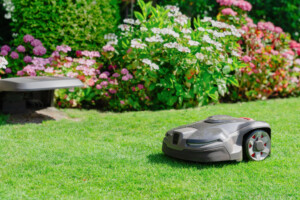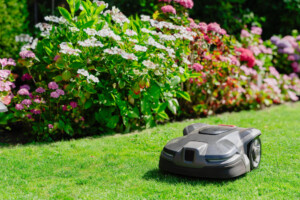
Ecovacs is betting that Americans are done messing with boundary wires, patchy mowing patterns, and weekend-after-weekend lawn duty. Its 2026 lineup of GOAT robot mowers leans on the same core tech powering self-driving-style navigation, RTK GPS, LiDAR, and AI, to map your yard and cut it with near-surgical accuracy.
The pitch is simple: set a virtual boundary in an app, let the mower build an automatic map, and watch it handle everything from tight corners to big open stretches, without burying a perimeter cable. Here’s what those technologies actually do, and how Ecovacs’ five headline models stack up for different yard sizes.
The tech behind the hype: RTK GPS, LiDAR, and AI
Ecovacs’ newest robot mowers revolve around three systems that work together: RTK navigation for pinpoint positioning, LiDAR for 3D obstacle detection and mapping, and AI to make smarter decisions when the yard changes. Combined, they’re designed to reduce the hands-on babysitting that older robot mowers often require.
The result is a mower that can automatically map the lawn, follow cleaner lines, and avoid wasting time re-cutting the same strips, while staying inside a virtual boundary you can adjust anytime.
RTK, short for Real-Time Kinematic positioning, uses satellite navigation with real-time corrections to deliver inch-level accuracy (roughly centimeter precision). In practical terms, that’s what allows these mowers to cover the whole yard evenly without installing a perimeter wire.
That precision also helps the mower avoid missed patches and excessive overlap, and it can reduce bumps into fixed objects. The catch: RTK works best with solid satellite reception, so yards with heavy tree cover or tricky sightlines may need extra attention during setup.
LiDAR + AI: 3D mapping and smarter obstacle avoidance
LiDAR uses laser scanning to create a detailed 3D view of the yard, spotting trees, garden beds, patio furniture, and other obstacles. Layer AI on top, and the mower can recognize what it’s seeing, adjust its route on the fly, and keep moving safely.
Ecovacs says the AI can also learn seasonal changes and adapt when the mowing area shifts, helpful if your yard layout evolves, you add new landscaping, or obstacles move around week to week.
The five Ecovacs GOAT models to watch in 2026, and who they’re for
Ecovacs’ GOAT range breaks into five standout models aimed at different yard sizes and complexity levels: the A1600 RTK, O1200 RTK, G1-2000, O800 RTK, and O600 RTK. All are built around autonomous mowing and app-based control, but their sweet spots vary.
GOAT A1600 RTK: the “most people” pick for medium-to-large yards
The GOAT A1600 RTK is positioned as the balanced option for homeowners who want high-end navigation without jumping to the biggest-capacity unit. It’s built for lawns up to about 1,600 square meters, roughly 17,200 square feet.
Ecovacs emphasizes automatic mapping, scheduled starts, automatic returns to the base, and dynamic adjustments for obstacles and weather shifts. The big selling point remains wire-free setup: no perimeter cable, just a virtual boundary.
GOAT O1200 RTK: a step down in size, not in brains
The GOAT O1200 RTK targets smaller properties while keeping the same core tech stack, RTK navigation, LiDAR, and AI-driven routing. It’s designed for lawns up to about 1,200 square meters, or roughly 12,900 square feet.
Through the app, users can split a yard into multiple zones and fine-tune mowing based on grass growth. Ecovacs also highlights more precise edge handling thanks to detailed automatic mapping.
GOAT G1-2000: built for big lawns, but it’s not RTK-first
If your property is closer to “mini-park” than “backyard,” the GOAT G1-2000 is aimed at large areas up to about 2,000 square meters, roughly 21,500 square feet. Ecovacs positions it as a robust, proven model for expansive lawns.
The tradeoff: it’s described as an older-generation approach that uses beacons, and it’s generally less precise than the RTK-based models. Still, for sheer coverage and durability, it’s pitched as a workhorse.
GOAT O800 RTK and O600 RTK: compact, wire-free options for smaller yards
For smaller lawns, Ecovacs points to the GOAT O800 RTK and O600 RTK as easier-to-own choices that still deliver RTK and LiDAR navigation. They’re meant to stay nimble in tighter spaces, narrow passages, and obstacle-heavy layouts.
The O600 RTK is designed for lawns up to about 600 square meters, roughly 6,500 square feet, while the O800 RTK sits in the middle for “standard” yards. Ecovacs frames both as low-maintenance, quick-setup models that don’t sacrifice mapping and obstacle avoidance.
Quick buyer’s guide: which GOAT should you choose?
The decision mostly comes down to yard size, layout complexity, and how much automation you expect. If you want a set-it-and-forget-it experience on a larger property, the A1600 RTK is positioned as the mainstream sweet spot. For smaller lawns, the O600 RTK and O800 RTK aim to deliver the same wire-free convenience with less capacity.
And if you’re shopping for a very large mowing area, the G1-2000 is the coverage play, just with a different navigation approach than the RTK-first models.
FAQ: what shoppers usually ask about RTK, LiDAR, and mapping
Is RTK really better than a “classic” robot mower?RTK’s inch-level positioning is what enables virtual boundaries and more consistent coverage, without burying a perimeter wire. It can also improve performance on complex or uneven lawns, assuming satellite reception is strong.
Does LiDAR make a mower safer?LiDAR continuously scans nearby space to detect obstacles, including pets, kids’ toys, and furniture, then reroutes quickly. Paired with AI, it’s designed to reduce collisions and damage.
Do you need constant internet for automatic mapping?Ecovacs’ approach suggests mapping can largely happen locally on the mower, while internet access mainly helps with app features, remote control, and software updates.
| 🔹 Sujet | 🔸 Robots tondeuses Ecovacs GOAT 2026 et technologies embarquées |
| 🔹 Technologies clés | Navigation RTK (précision centimétrique), LiDAR (cartographie 3D), IA (adaptation intelligente) |
| 🔹 Innovation majeure | Fonctionnement sans fil/câble périphérique grâce à la cartographie automatique |
| 🔹 Bénéfices principaux | Tonte homogène, gain de temps, réduction des interventions humaines |
| 🔹 Modèles phares | A1600 RTK, O1200 RTK, G1-2000, O800 RTK, O600 RTK |
| 🔹 Positionnement | Du petit jardin (600 m²) aux grandes surfaces (2000 m²) |
| 🔹 Modèle recommandé | A1600 RTK pour polyvalence, G1-2000 pour grandes surfaces, O600/O800 pour petits terrains |
| 🔹 Sécurité & précision | Détection d’obstacles avancée, adaptation en temps réel, limitation des collisions |
| 🔹 Critères de choix | Surface du terrain, complexité du jardin, niveau d’automatisation souhaité |
| Modèle | Surface de tonte max (m²) | Navigation rtk | Technologie lidar | Intelligence artificielle (ia) | Cartographie automatique | Fil/câble périphérique |
|---|---|---|---|---|---|---|
| a1600 rtk | 1600 | Oui | Oui | Oui | Oui | Non |
| o1200 rtk | 1200 | Oui | Oui | Oui | Oui | Non |
| g1-2000 | 2000 | Oui | Oui | Oui | Oui | Non |
| o800 rtk | 800 | Oui | Oui | Oui | Oui | Non |
| o600 rtk | 600 | Oui | Oui | Oui | Oui | Non |
| Superficie (m²) | Modèle recommandé |
|---|---|
| Jusqu’à 600 | o600 rtk |
| 601 – 800 | o800 rtk |
| 801 – 1200 | o1200 rtk |
| 1201 – 1600 | a1600 rtk |
| 1601 – 2000 | g1-2000 |