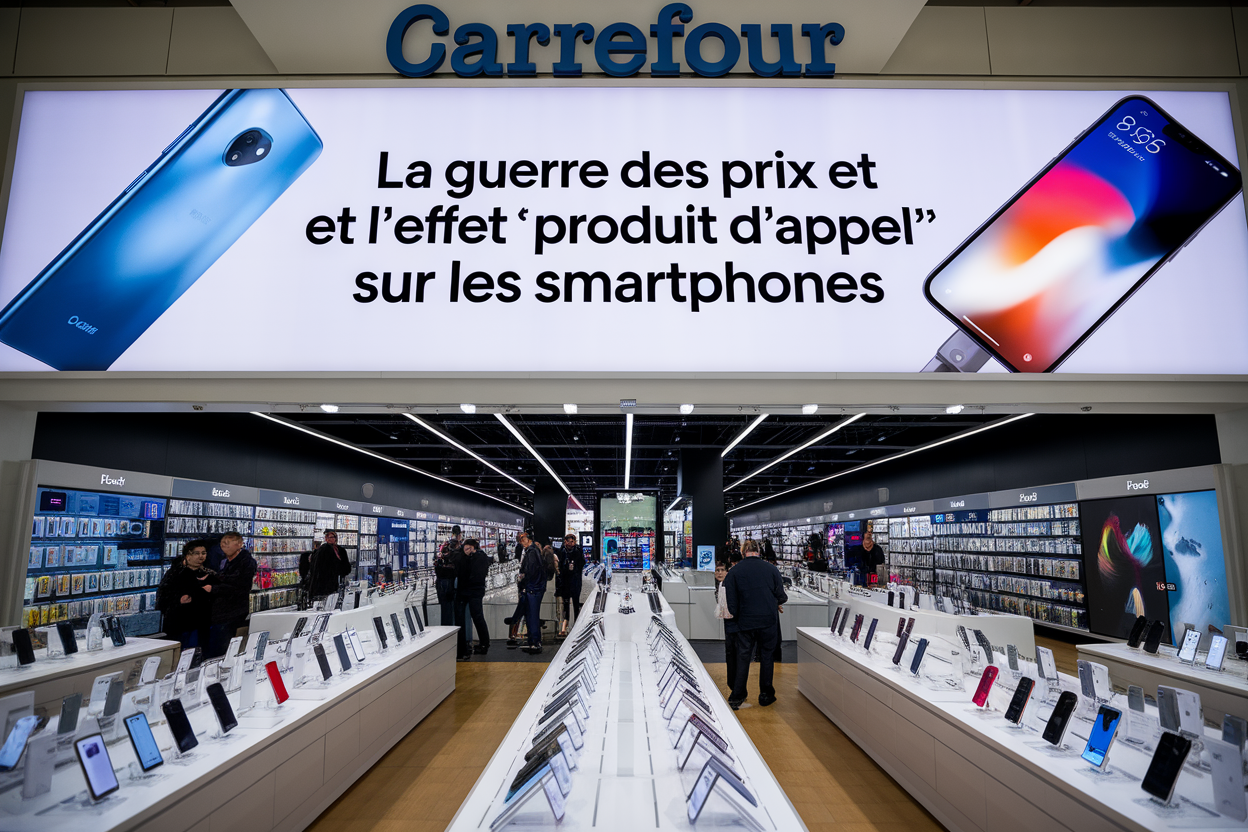
One of France’s biggest retailers is dangling a once-premium Samsung phone for about the price of a budget handset. Carrefour is advertising the Galaxy S21+ for under €200, roughly $215, according to the French newspaperLe Parisien, a price that undercuts what shoppers typically see for the S21 line on comparison sites and online marketplaces.
It’s the classic retail play: splashy red banner, a headline-grabbing number, and a recognizable “flagship” name meant to pull people into stores and onto product pages. But deals this aggressive often come with strings attached, limited stock, loyalty-program requirements, trade-in conditions, or online-only availability, making the details as important as the sticker price.
A former flagship drops into budget-phone territory
Le Parisienspotlighted Carrefour’s promotion as a standout because it pushes a Galaxy “S” model, Samsung’s long-running high-end line, below the €200 mark (about $215). In the U.S., that’s the kind of price you’d associate with entry-level Android phones, not a device that once sat near the top of Samsung’s lineup.
The point isn’t just the discount. It’s visibility. Big-box retailers use recognizable electronics as “loss leaders” to drive traffic, then make money on accessories, warranties, and other purchases. When the psychological barrier drops below €200, the offer stops feeling merely competitive and starts feeling like a can’t-miss event, at least at first glance.
Still, the article urges caution: the most eye-popping promotions often hinge on specific terms. Shoppers who don’t read the conditions can end up seeing one price in the ad and a different reality at checkout.
Why the Galaxy S21 line is ripe for steep markdowns
The Galaxy S21+ comes from a generation when Samsung split its flagship into three tiers: the standard S21, the larger S21+, and the top-end S21 Ultra. That tiering shapes resale value and discount behavior, higher-end models can hold value longer, but they can also see dramatic price cuts when retailers need to clear inventory.
Other pricing examples cited in the French coverage show just how scattered the market has become. One deal referenced the Galaxy S21 Ultra, which launched at €1,259 (about $1,360) and has been listed around €839.47 (about $905) on Rakuten, a marketplace that functions somewhat like a mix of Amazon and eBay in the U.S.
Another example highlighted an S21 Ultra configuration with 128GB of storage and 12GB of RAM, running Android with 5G support, specs that still feel perfectly usable years later, especially now that 5G is standard across major carriers.
The standard Galaxy S21, meanwhile, is sometimes viewed as less “premium” because it uses a plastic back, one reason the S21+ can look like the sweet spot when discounts get aggressive.
Carrefour’s real goal: traffic, not tech bragging rights
For a mass-market retailer like Carrefour, a smartphone isn’t just a gadget, it’s a magnet. Promotions are designed to cut through the noise of constant online price comparisons and get shoppers to click, browse, and buy more than just the phone.
Carrefour can also layer in its own retail mechanics, loyalty perks, limited-time promos, bundles, so the profit isn’t necessarily tied to the phone itself. A well-known Samsung model at a jaw-dropping price becomes the front door.
Le Parisienalso pointed to a very different kind of Samsung promotion at Carrefour: an immediate €200 discount (about $215) tied to preorders of the Galaxy S26. That’s a launch tactic for a new device, not a clearance-style price floor for an older one. Same retailer, two timelines, one strategy: dominate attention.
Before you buy: check the model, condition, storage, and the catch
When a former high-end phone suddenly looks cheap, the details matter. Start with the exact model: S21, S21+, and S21 Ultra aren’t just different sizes, they differ in materials, camera hardware, and overall positioning.
Next, confirm the condition. Is it new, refurbished, or sold through a third-party marketplace seller? Ultra-low pricing can signal end-of-stock inventory, refurbished units, or a deal that only works if you meet specific requirements.
Then look at the configuration. Storage and RAM affect day-to-day performance and resale value. The French reporting cites 128GB/12GB RAM on an S21 Ultra as an example of why these phones still attract buyers; the S21+ also comes in multiple configurations depending on market and batch.
Finally, read the terms. Limited quantities, short promo windows, pickup rules, loyalty enrollment, or other restrictions can turn a headline price into a hard-to-get price. The bigger takeaway: the Galaxy S21+ here is less a tech story than a retail signal, and when that signal drops below about $215, competitors have to respond, at least in the battle for shoppers’ attention.
One phone, wildly different prices depending on where you shop
The French coverage underscores a market where “the price” of a phone is no longer a single truth. Big retailers run tightly controlled promotions amplified by deal coverage, while marketplaces float a wide range of listings that vary by seller, condition, and specs.
Put those worlds together and you get the current reality: an older flagship can be positioned as a premium device in one place, a refurbished bargain in another, and a doorbuster traffic driver at a supermarket-hypermarket chain like Carrefour.
If Carrefour really is putting the S21+ under €200 (about $215) with minimal hurdles, it’s a shot across the bow in Europe’s retail price wars, and another sign that yesterday’s flagships are becoming today’s most powerful promotional weapons.