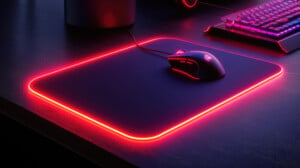
For years, buying a gaming mouse pad was muscle memory: grab a SteelSeries QcK or a Razer Goliathus and call it a day. Not anymore.
In 2026, mouse pads have turned into full-blown desk gear, oversized mats that swallow your keyboard, RGB lighting that syncs with your PC, and a wave of custom designs that look more like streetwear than “tactical black.” Over the past six months, we rotated a dozen popular pads through real-world use, Valorant and Counter-Strike 2 grind sessions, MOBAs, MMOs, and everyday work, to see what actually holds up.
Here are the seven that rose to the top, ranked by value and matched to the kind of player they’re built for.
A French upstart is winning on design, and cheap customization
La Planète Gaming is the surprise hit here, mostly because it sells something the big legacy brands still don’t: personality at a reasonable price. The lineup runs from standard sizes around 11.8 x 23.6 inches (30 x 60 cm) up to desk-covering XXL mats at roughly 19.7 x 39.4 inches (50 x 100 cm).
Prices start at €19.90, about $22, and at that level you rarely get a stitched edge, machine-washable build, and high-definition printing in one package. The brand leans hard into themed collections, especially Japanese-inspired art (dragons, wave prints, kanji-style graphics) using a “Never-Fade” process designed to survive washing.
The bigger flex is customization: upload a photo, a team logo, or your own design and they’ll print it on demand, something the major gaming giants typically reserve for pricier specialty runs. There are also RGB versions with USB-powered edge lighting on extended sizes.
Technically, it’s the familiar cloth-pad formula done well: microfiber surface for smooth glide, a natural rubber base, stitched anti-fray edges, and wash tolerance. Shipping is free, and the site advertises a “LPG10” code for 10% off. This is for players who want their desk to look like theirs, without paying €80 (about $88) for a premium hard-surface pad like Razer’s Atlas.
SteelSeries QcK Heavy XXL is still the esports “don’t overthink it” pick
The QcK has been a pro staple for more than 15 years, and the Heavy XXL version is the most refined take: about 35.4 x 15.7 inches (90 x 40 cm) and roughly 0.24 inches thick (6 mm). It’s a micro-woven cloth surface on a grippy rubber base, tuned for control rather than pure speed.
At around €35 (about $39), you’re not paying for RGB, branding theatrics, or customization. You’re paying for consistency, tracking that feels almost lab-clean and a pad that can take years of abuse without warping. Competitive FPS players stick with it because it forgives aggressive wrist flicks and stays predictable over time.
Razer’s Goliathus Extended Chroma remains the RGB benchmark
If your setup lives on camera, or you just want your desk to glow, Razer still sets the standard. The Goliathus Extended Chroma measures about 36.2 x 11.4 inches (92 x 29 cm) and pumps out the full “16.8 million colors” palette through Razer Synapse, with clean, even lighting along the edges.
It typically runs €60 to €70 (about $66 to $77). That’s expensive for a mouse pad, but it makes more sense if you’re already deep in Razer’s ecosystem. The tradeoff: cloth surfaces show grime fast, and cleaning is trickier because of the built-in electronics.
Corsair’s MM700 plays in the same RGB sandbox as Razer, but adds something genuinely practical: an integrated USB pass-through port. Size is about 36.6 x 15.7 inches (93 x 40 cm), with lighting controlled through Corsair’s iCUE software.
Pricing usually lands between €65 and €80 (about $72 to $88). If you’re short on ports, especially on a desktop tower tucked under a desk, that built-in USB can justify part of the premium. Otherwise, you’re largely paying for Corsair’s ecosystem and a sturdy, confidence-inspiring build that stays put even on slick surfaces like glass.
Logitech G440 is the hard pad for FPS purists who want raw speed
The Logitech G440 is the outlier: a rigid plastic surface built for speed, not comfort. It’s about 13.4 x 11 inches (34 x 28 cm) with a rubber base, designed for high-DPI optical sensors and players who want near-zero friction.
At around €25 (about $28), it’s relatively affordable, but it’s not a cozy all-day pad. Expect less wrist comfort and more noise. For certain players, think old-school arena shooter fans or Counter-Strike diehards who love a fast, snappy glide, it’s exactly the point.
HyperX Pulsefire Mat XL is the value pick that keeps up with the classics
The Pulsefire Mat XL is easy to overlook, which is why it’s such a strong deal. At about 35.4 x 16.5 inches (90 x 42 cm), it’s a big desk mat for around €25 (about $28) that performs in the same neighborhood as the QcK XXL.
The cloth is tightly woven with a glide that splits the difference between control and speed. The base grips well enough, and the stitched edges hold up, even after multiple trips through the wash. If you want a solid pad without paying the “premium brand tax,” this is the no-drama recommendation.
Cooler Master MP511 is the budget option that doesn’t feel cheap
The MP511 leans on Cordura fabric for durability and comes in multiple sizes, including an XXL option around €25 (about $28). The texture is rougher than a QcK, which some players actually prefer because it can feel faster under the mouse.
It’s stitched, it grips, and it keeps the design simple. No RGB. No customization. Just a straightforward pad that works, ideal as a first buy or a second setup pad.
How to pick a gaming mouse pad: size, surface, and play style
Size:If you play low sensitivity in FPS games, roughly 400 to 800 DPI, and make big arm movements, you’ll want at least an XXL pad around 31.5 x 11.8 inches (80 x 30 cm), with 35.4 x 15.7 inches (90 x 40 cm) as the sweet spot. MOBA and MMO players can usually get away with something closer to 17.7 x 15.7 inches (45 x 40 cm). Giant “3XL” pads over about 39.4 inches (1 meter) wide are only worth it if your desk is at least about 47.2 inches (120 cm) across.
Material:Cloth pads dominate because they’re forgiving and comfortable. Hard plastic pads are for maximum speed and minimal friction. Hybrid surfaces try to split the difference, often faster than cloth, more comfortable than rigid, but usually cost more.
For FPS:Control pads (like the SteelSeries QcK or HyperX Pulsefire) suit players who rely on precise micro-adjustments and controlled flicks. Speed pads (like the Logitech G440, or premium glass options) fit players who want effortless glide and don’t mind a less forgiving surface. Neither is “best”, it’s about what your aim style demands.
Our verdict
There’s no universal mouse pad, only the one that fits how you play. If you want the safest bet for competitive FPS, the SteelSeries QcK Heavy XXL is still the default answer because it’s consistent and durable. If your desk is part of your show, Razer and Corsair lead the RGB pack, especially if you already use their software ecosystems.
But the most 2026 trend is customization, and that’s where newer brands are punching above their weight. La Planète Gaming stands out by offering bold themed designs and affordable custom printing starting around $22, proof that your mouse pad doesn’t have to look like everyone else’s to perform like a serious piece of gear.
| 🔹 Élément | 🔸 Information |
|---|---|
| 🎯 Objectif | Comparer 7 tapis de souris gaming selon usage, prix et profil joueur |
| 🇫🇷 Marque émergente | La Planète Gaming mise sur design, personnalisation et prix bas (dès 19,90 €) |
| 🏆 Valeur sûre eSport | SteelSeries QcK Heavy XXL: précision, durabilité, idéal FPS compétitif |
| 🌈 Option RGB | Razer Goliathus et Corsair MM700 dominent avec éclairage et écosystèmes logiciels |
| ⚡ Performance pure | Logitech G440 (rigide) privilégie vitesse et réactivité, moins confortable |
| 💰 Meilleur rapport qualité/prix | HyperX Pulsefire Mat XL et Cooler Master MP511 offrent fiabilité à bas coût (~25 €) |
| 📏 Critère taille | XXL recommandé pour FPS bas DPI, formats plus petits pour MOBA/MMO |
| 🧵 Matières | Tissu (contrôle), rigide (vitesse), hybride (compromis) |
| 🧩 Tendance 2026 | Personnalisation en forte croissance, accessible dès 25–30 € |