
If you’ve ever watched a cheap, off-the-shelf tarp shred in a stiff wind, or pool rainwater until it sags like a hammock, you already know the dirty secret of “one-size-fits-all” protection: it rarely fits, and it rarely lasts.
In France, manufacturers are pushing a different pitch for 2026: custom-made tarps designed to match exact measurements, stand up to harsh weather and UV exposure, and cut long-term replacement costs. The idea is simple, buy the right cover once, instead of buying the wrong cover over and over.
For American homeowners, small business owners, and anyone hauling equipment on a utility trailer, the appeal is familiar: a made-to-order tarp can protect patios, outdoor furniture, jobsite tools, farm supplies, and cargo with fewer gaps, less flapping, and better durability than standard big-box options.
Why custom beats “close enough” from the store
Retail tarps are built for broad use, not your specific setup. That’s why they’re often too big, too short, or awkwardly shaped, leaving corners exposed, letting water sneak in, or catching wind like a sail.
Custom manufacturing flips that. You provide the dimensions, and the tarp is built to match, down to the fraction of an inch. That tighter fit can mean fewer leaks, less wear from constant movement, and a cleaner, safer setup for transport and storage.
Another advantage: guidance. A specialist can steer buyers toward the right material, attachment method, and grommet placement, so you’re not guessing in an aisle or trying to “make it work” with bungee cords and hope.
Common custom options include reinforced edges, extra grommets, hook-and-loop (Velcro-style) closures, and other finishing details that standard tarps rarely offer.
A budget play that can actually last
The French article makes a point that resonates in the U.S.: “cheap” doesn’t have to mean disposable. A lower-cost custom tarp works when it’s designed around what you truly need, no wasted material, no unnecessary add-ons, and fewer failure points.
For homeowners, that can mean better protection for patio furniture, grills, outdoor cushions, and seasonal gear. For contractors and other pros, it can mean a more reliable cover for tools, materials, and equipment that live outside or travel frequently.
The payoff is often long-term: fewer replacements, less damage from weather, and less time spent re-tying, re-tensioning, or patching torn corners.
Materials matter: PVC, coated polyester, and specialty fabrics
Durability starts with the fabric. Manufacturers typically offer several technical materials depending on how and where the tarp will be used.
PVC remains a go-to for heavy-duty needs because it’s tough, waterproof, and easier to clean, especially for setups exposed to repeated rain, snow, and strong sun. For frequent handling or mobile use, PVC-coated polyester can be easier to manage while still holding up under stress.
Some tarps also come with specialized treatments, UV resistance, anti-mildew coatings, or fire-retardant properties, useful for certain industrial settings or regulated environments.
Where custom tarps show up: patios, pergolas, trailers, farms, and worksites
Custom tarps aren’t just for one niche. On a patio, a fitted cover can block wind and extend outdoor use into shoulder seasons. On a pergola, a tailored roof panel can turn an open frame into a more weather-ready space when rain rolls in.
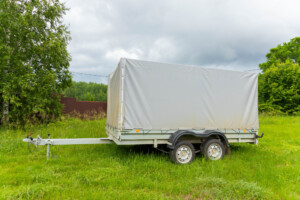
For transportation, a tarp cut to the exact size of a utility trailer reduces wind drag and flapping, two things that can loosen tie-downs and wear out fabric fast. In agriculture and industry, the same logic applies to protecting feed, grain storage, temporary equipment staging, and long-term outdoor storage.
The common thread is fit: less slack, fewer folds that collect water, and fewer exposed edges.
Ordering online: the “configurator” approach
Many manufacturers now sell custom tarps through online configuration tools. Buyers enter measurements, choose shape, thickness, color, and finishing options, then get an instant quote.
The article also highlights add-ons like printed logos or text, useful for businesses labeling equipment covers or creating branded barriers at events and worksites.
Made in France, and what that means for U.S. readers
The original piece leans hard on “Made in France” as a quality signal, similar to how “Made in USA” or “American-made” is used in U.S. marketing. The argument: tighter quality control, clearer material sourcing, faster turnaround, and easier customer support if something needs adjusting.
For American buyers, the takeaway isn’t that you need a French tarp, it’s that local or regional manufacturing can matter when you’re ordering something custom. Shorter shipping routes can also reduce costs and headaches, especially for oversized items.
What to look for before you buy
If you’re considering a custom tarp, the practical checklist is straightforward: measure carefully, think through wind exposure and water runoff, and choose attachment points that match how you’ll actually secure it, grommets, straps, rails, or hook-and-loop closures.
As extreme weather and hotter summers put more stress on outdoor gear, the market is moving toward tougher, better-fitting protection. For a lot of people, that means the “upgrade” isn’t a new patio set or a new trailer, it’s the cover that keeps the expensive stuff underneath in one piece.
| 🔎 Élément clé | 📌 Information essentielle |
|---|---|
| 🎯 Choix stratégique | Bâche sur mesure = adaptation parfaite aux besoins vs solutions standard souvent inadaptées |
| 💰 Rapport qualité/prix | Personnalisation = coût optimisé (pas d’options inutiles) + meilleure durabilité |
| 🛡️ Protection & usages | Protège équipements, terrasses, remorques, agriculture → usage polyvalent pro & particulier |
| 🧵 Matériaux clés | PVC (robustesse/UV), polyester (léger), tissus techniques (spécifiques) → choix selon usage |
| ⚙️ Personnalisation | Configurateur en ligne: dimensions, finitions, couleurs, accessoires → solution rapide et précise |
| 💡 Insight expert | Le sur-mesure permet de prolonger la durée de vie tout en réduisant les coûts à long terme |
| Matériau | Avantages principaux |
|---|---|
| PVC | Imperméable, résistant aux UV, très robuste |
| Polyester enduit | Léger, manipulation facile, bonne durabilité |
| Tissu technique | Adapté aux exigences spécifiques (ignifuge, anti-moisissure…) |
| Usage | Matériau conseillé |
|---|---|
| Exposition solaire répétée | PVC traité anti-UV |
| Changement/voyage fréquent | Polyester léger |
| Risques chimiques ou feu | Tissu technique spécialisé |
Frequently Asked Questions
Why choose a custom-made tarp instead of a standard model?
A custom-made tarp is tailored precisely to your dimensions and usage constraints. It provides better protection, reduces leaks, improves long-term durability, and avoids common issues with poorly fitting standard models.
Which material should you choose for a tarp that’s resistant to UV rays and bad weather?
PVC remains one of the most recommended materials for its strength, waterproofing, and UV resistance. Coated polyester is also suitable when you need something lighter and more flexible, while certain technical fabrics meet specific requirements.
What are the benefits of ordering from a French tarp manufacturer?
Working with a French manufacturer means better support, local expertise, strict quality checks, and greater responsiveness for customization, delivery, or after-sales service.