
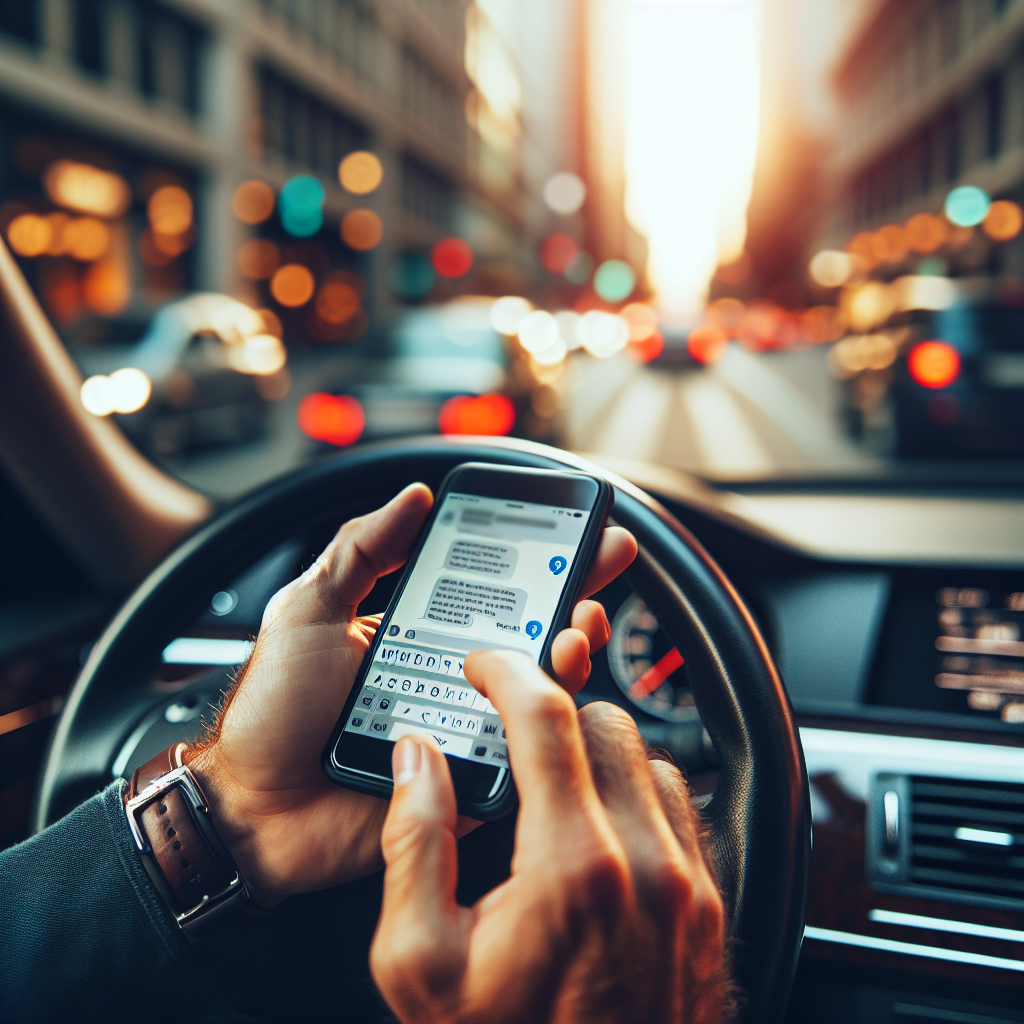
French drivers caught holding a phone behind the wheel could soon lose their licenses immediately, no speeding ticket, no fender-bender, no second violation required.
Two local governments in southwest France are already testing the tougher approach: an automatic, on-the-spot license suspension for up to six months for drivers caught using a handheld phone. The experiment is fueling a bigger question now bubbling up in Paris: should this become the national standard?
A crackdown that goes beyond a fine
Under France’s current rules, using a phone while driving typically brings a €135 ticket, about $150, and a three-point hit on the country’s point-based license system. Until now, an immediate suspension generally required phone use plus another violation at the same time.
But the prefectures, local arms of the French state, of Landes and Lot-et-Garonne are pushing further. They’ve moved toward an automatic, immediate suspension of up to six months for handheld phone use even when it’s the only offense, a sharper penalty designed to hit drivers where it hurts: their ability to drive to work, school, and daily life.
Why officials say the phone is the real danger
Road-safety officials argue the risk is straightforward: phone distraction dramatically raises crash odds. French safety statistics commonly cite a tripling of accident risk when a driver uses a phone.
The physics are just as blunt. At 31 mph, about 50 km/h, taking your eyes off the road for two seconds means traveling roughly 102 feet blind. That’s enough distance to miss a stopped car, a cyclist, or a pedestrian stepping off the curb.
Enforcement data underscores how common the behavior remains. In Landes alone, authorities say more than 3,000 drivers were ticketed in 2025 for phone use behind the wheel, suggesting the real number of offenders is likely far higher.
Supporters want a “shock” effect; critics call it overkill
Backers of the policy say the point is deterrence. Pierre Lagache, a figure associated with France’s road-violence prevention advocates, has argued that handheld phone use has become a modern plague on the roads, and that only a hard penalty will change habits.
Opponents counter that an automatic suspension treats a “minor” mistake like a major offense. Jean-Baptiste Josca, a spokesperson for the French drivers’ group “40 Millions d’Automobilistes,” has criticized the approach as disproportionate and says education and awareness should do more of the work than punishment.
Early results from the southwest pilot appear encouraging, with local officials citing a drop in phone-related crashes, at least temporarily. But even supporters acknowledge a familiar problem in traffic enforcement: the “new rule” effect can fade once drivers believe the spotlight has moved on.
How this compares to the U.S. and other countries
For Americans, the debate will sound familiar. In the U.S., distracted-driving laws vary widely by state. Many states ban handheld phone use, but penalties often start as fines, serious, but rarely life-disrupting in the way a license suspension can be.
France is looking more toward countries that treat phone use like a high-level safety threat. Parts of Australia have embraced tougher enforcement, and the U.K. can impose steep penalties and escalating consequences for repeat offenders. Japan is also known for strict sanctions, including immediate suspensions in certain cases.
The global trend is clear: as phones become more embedded in daily life, governments are increasingly willing to impose harsher consequences to keep screens out of drivers’ hands.
What a nationwide rule could mean in France
If France expands the policy nationwide, officials expect fewer distraction-related crashes, potentially a meaningful public-safety win in a country that has a long history of using tough rules to cut road deaths, from seat belt mandates to speed enforcement.
But the blowback could be real. In many parts of France, especially smaller towns and rural areas, losing a license can mean losing a job. A six-month suspension isn’t just a punishment; it can be an economic shock.
There’s also the question of enforcement capacity and fairness. To apply the rule consistently, police need training, clear standards, and tools that can support citations without turning traffic stops into subjective disputes.
The bigger fight: punishment vs. prevention
The French debate is about more than one penalty. It’s about whether modern road safety can rely on deterrence alone, or whether governments need to pair crackdowns with sustained public education and technology that reduces temptation, such as phone “drive mode” lockouts.
France has repeatedly shown it’s willing to take unpopular steps in the name of safety. If the handheld-phone suspension goes national, it could reshape driving culture, and signal that, in the eyes of the state, a phone in your hand is no longer a minor infraction but a major threat.

Key Takeaways
- Using a phone while driving is a major cause of accidents in France.
- License suspension for using a phone while driving is being tested in certain regions.
- This measure could become the national standard to strengthen road safety.
Frequently Asked Questions
What are the current penalties for using a phone while driving in France?
A €135 fine, a three-point deduction from your driver’s license, and a possible suspension if another offense is committed at the same time.
What are the arguments for and against suspending a driver’s license for using a phone while driving?
Supporters say it’s necessary to reduce accidents, while opponents считают the measure excessive and advocate for awareness and education instead.